
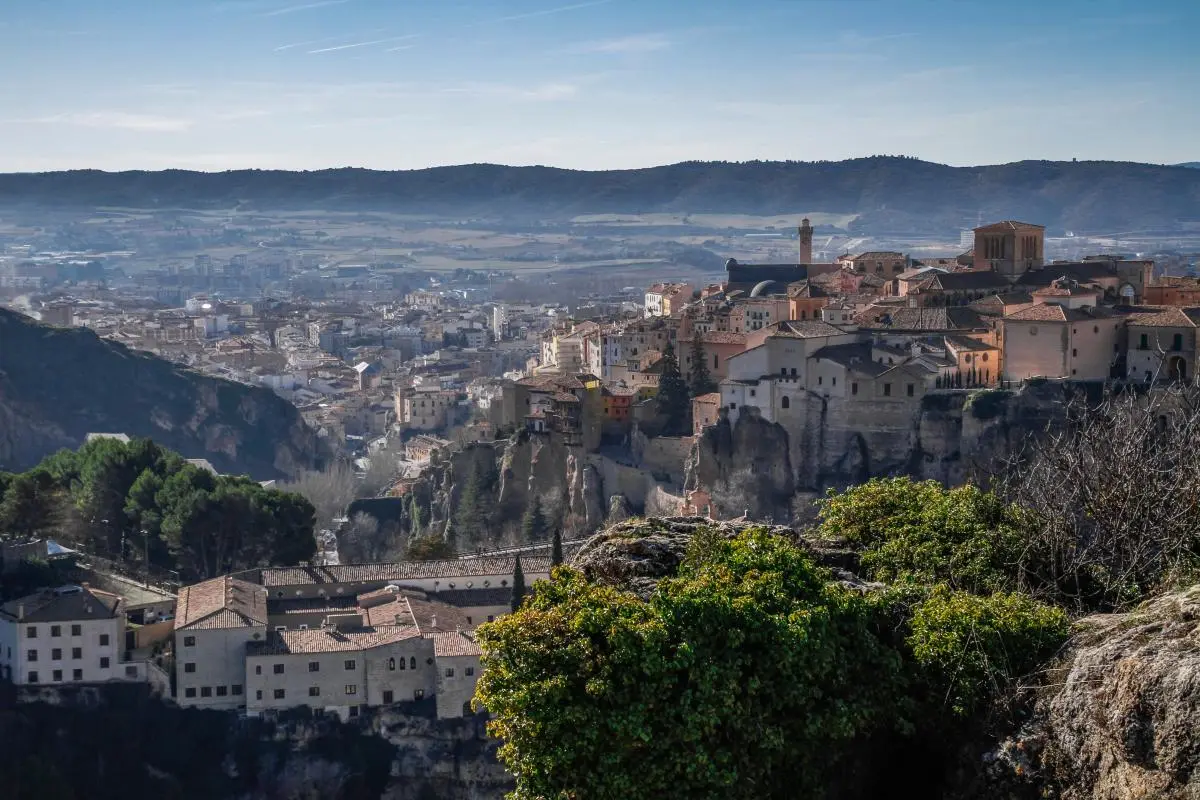
Cuenca, a city with “hanging houses” overlooking the Uecar River Gorge, is recommended to tourists as an alternative to Madrid and Barcelona. The World Heritage Site is located less than a two-hour drive from the Spanish capital, according to The Olive Press.
Founded by the Moors, the city stands on a limestone outcrop above the Júcar and Uecar rivers in the Castilla-La Mancha region. The historic city center remains intact, featuring city walls, steep cobblestone streets, and the ruins of a medieval castle. Cuenca is also known as a center for abstract art. From the central Plaza Mayor, with its arcaded town hall and late 12th-century cathedral, a street leads to the city’s main landmark.
Houses Clinging to the Cliffs
The Casas Colgadas (Hanging Houses) overlook the gorge and seem to cling to the edge of the cliff. Three of them are open to visitors: the Casa de la Sirena houses a restaurant, while the Casas del Rey are home to the Museum of Spanish Abstract Art, featuring works by Tàpies, Chillida, and Saura. The best views are from the San Pablo iron pedestrian bridge, on the opposite side of which stands the San Pablo Monastery—one of the best places to stay overnight. At night, bathed in the glow of spotlights, the houses look even more spectacular.
According to UNESCO, Cuenca is located 170 km southeast of Madrid, and its historic walled city covers 23 hectares. The “hanging houses” were built in the late Middle Ages near the Bishop’s Palace, and most of them were rebuilt in the 16th century in a narrow, tall style: three or more stories, with two or three rooms on each. The local 12th-century cathedral, built on the site of the former Great Mosque, became Spain’s first Gothic cathedral. At the same time, the organization cites tourist pressure as one of the main threats to the old town: the influx of visitors, commercial activity in public spaces, and traffic, according to UNESCO.
Museums, Taverns, and the “Enchanted City”
Among Cuenca’s unusual sites are a “skyscraper” in the San Martín neighborhood and a walkable tunnel on Alfonso VIII Street. Museum lovers should visit the Antonio Sauri and Antonio Pérez collections, the science museums, and the Easter Museum, dedicated to the city’s most famous local holiday. Restaurants and bars are concentrated around the Plaza Mayor and in the Castillo neighborhood in the upper part of the city, with viewing platforms overlooking the gorge. There are also restaurants featuring signature cuisine, flamenco taverns, and a bar on the ground floor of the palace.
In the summer, you can go for a swim at the Os del Júcar recreation area or hike the Cerro del Socorro trail. Located 30 km from the city is the “Enchanted City” (Ciudad Encantada), with weathered rock formations, some of which resemble animals or people.