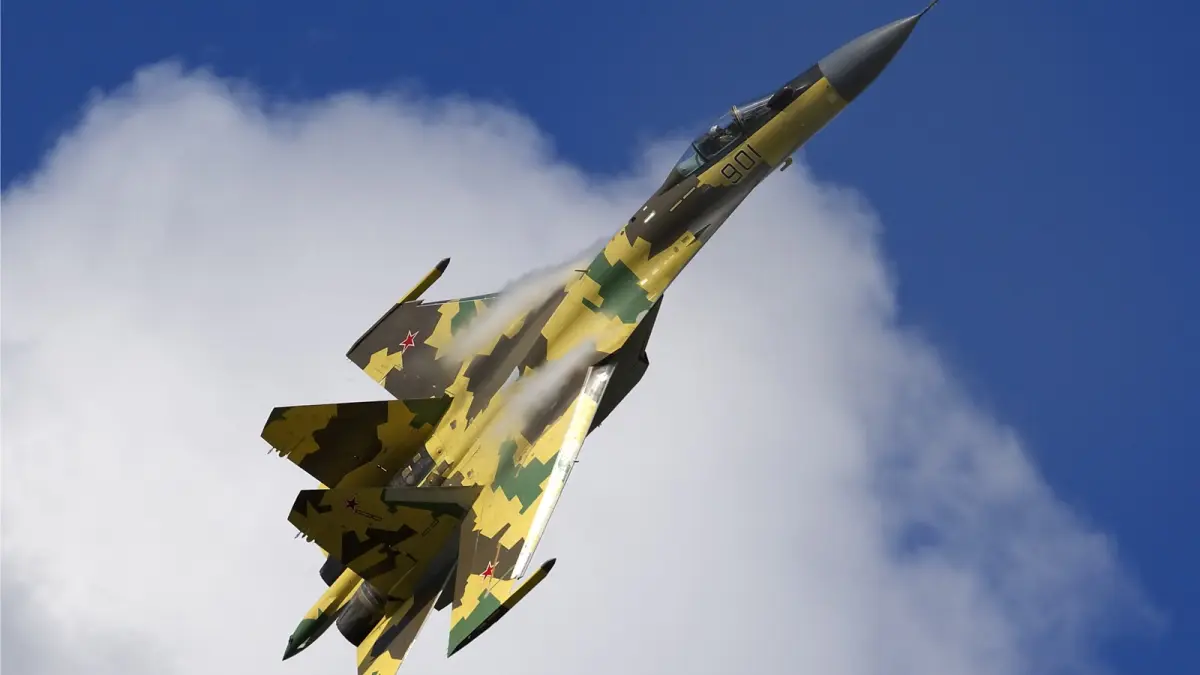
Ethiopia has become the third foreign country, after China and Algeria, to have Russian Su-35 fighter jets in service. Moscow delivered 12 aircraft in a single shipment and also promised four batteries of S-400 air defense missile systems, according to Defense Romania.
Ethiopian Prime Minister Abiy Ahmed announced the delivery of the aircraft on October 28. He thanked Vladimir Putin for delivering the fighter jets a year ahead of schedule and stated that the new equipment allows the country to preemptively deter aggression. The prime minister did not specify the delivery dates for the S-400s.
“By equipping itself with these fighter jets, Ethiopia has taken a leading position among sub-Saharan African countries,” Abiy Ahmed wrote on X.
Aircraft Rejected by Cairo
The pace of deliveries raises questions. According to Ukrainian intelligence data published by UNIAN, Russia produces approximately 10–12 Su-35s per year. Manufacturing 12 aircraft from scratch would mean that the aviation industry would have to work exclusively for Ethiopia for an entire year.
Experts at Defence Express believe that these are most likely aircraft intended for Egypt. Under pressure from the U.S., Cairo rejected them in 2020 and allowed the UAC corporation to resell the aircraft. Official Ethiopian photographs show camouflage patterns similar to the Egyptian scheme. Russia manufactured 24 Su-35SE aircraft for Egypt, and they sat idle there for over five years. At one time, these aircraft were intended for Iran, but the deal never went through.
According to experts, the S-400 launchers could be taken from the Kapustin Yar test site. There are still about 14 51P6A launchers there that have not yet been converted to fire missiles for the war in Ukraine. Currently, Ethiopia’s air defense relies on outdated S-75M3 and S-125M1 systems, as well as six “Pantsir-S2” systems.
Weapons Amid the War in Tigray
Abiy announced the deal in Moscow during the “Russia–Africa” summit. The deliveries coincided with the resumption of hostilities in Tigray in late September, which effectively shattered the 2022 Pretoria Peace Agreement. Meanwhile, unrest continues in Amhara, and fears are growing over a possible war with Eritrea, Al Jazeera reports.
Benedict Manzin, a leading analyst at the consulting firm Sibylline, cautions against drawing a direct link between the previously agreed-upon purchases and the latest developments on the front lines. At the same time, he highlights the potential role of the new equipment in the regional conflict.
“In a war with Eritrea, they could be used against Eritrea’s limited air force and drones,” Manzin notes.
For Moscow, this deal means both profit and influence. According to SIPRI, Russia accounted for 15% of imports of major weapons systems to Africa between 2021 and 2025. Only the United States and China supplied more. Putin also stated that in the first nine months of 2026, trade between the two countries exceeded $1.3 billion.
Ethiopia has long been purchasing Russian combat aircraft. In 1998–1999, it received Su-27s for the war with Eritrea, and in January 2024, it acquired two Su-30Ks. In January 2026, the government announced a plan to double the capacity of its air force and reach fifth-generation capabilities within five years, according to Defence MENA.