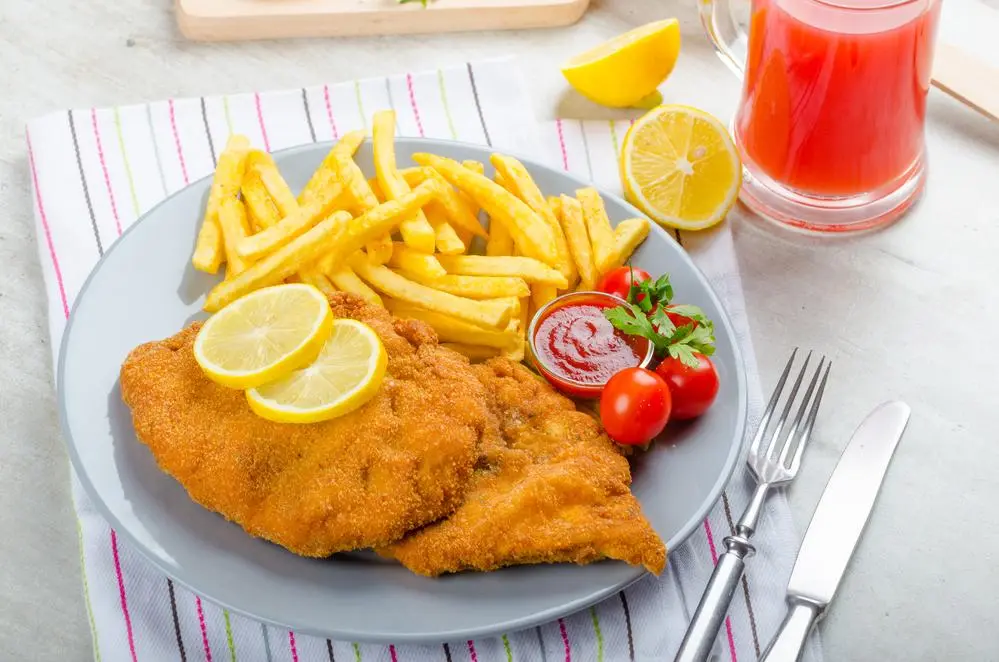
Tough meat, a greasy crust, and breading that falls off at the first touch of a knife—these are the most common problems with breaded cutlets. They can be avoided by steering clear of a few typical mistakes. A Hungarian publication compiled the seven most common ones based on advice from Viennese chefs, according to KertVár.
The closest relative of the Hungarian schnitzel is the Viennese schnitzel. According to the Austrian Ministry of Agriculture, a recipe for breaded fried meat was mentioned as early as 1798 in an Austrian cookbook.
The first mistake is using a piece of meat that is too thick or uneven. Such a schnitzel cooks faster on the outside than on the inside, and the crust burns before the meat is cooked through. A recipe from Vienna’s official tourism website recommends pounding the meat to a thickness of 2–4 mm, while other Viennese recipes specify 5 mm.
You should pound the meat from the center toward the edges using the smooth side of the meat mallet, not the ridged side, which tears the fibers. If you cover the meat with plastic wrap, it won’t splatter, and its surface will remain intact.
Why Does a Cutlet “Buckle” in the Pan?
The second mistake is not scoring the edges. The thin membrane and tendons at the edge of the cut contract during frying, causing the cutlet to curve and cook unevenly. The Austrian National Tourist Office recommends removing the membranes before tenderizing, while chef Peter Kirischitz suggests making shallow cuts in the tendons.
It’s enough to make a few cuts a few millimeters deep with a sharp knife. This is especially important for pork loin, which often has a thicker layer of membrane along the edge.
What They Do at Vienna’s Most Famous Schnitzel Restaurant
At the Viennese restaurant Figlmüller, which calls itself the home of the “only true Viennese schnitzel,” pork cutlets are pounded to exactly 4 mm thick and 30 cm in diameter. They cut and pound the meat only after an order is placed, whereas other restaurants, according to chef Markus Brunner, prepare the cutlets in the morning, which makes them less juicy.
“We cut and pound it immediately after an order is placed because we need the moisture from the meat to create a soufflé-like texture between the meat and the breading,” Brunner emphasizes. The schnitzel is fried in the restaurant sequentially in three pans with sunflower oil—the temperature of which is kept a secret—while the Viennese veal schnitzel is fried in melted butter, according to the BBC.
Andreas Suchomel-Rappl, head chef at the Viennese restaurant Meissl & Schadn, where about 400 schnitzels are prepared daily, cites the temperature of the fat as one of the key factors for success and admits that when breading, he presses the breading firmly against the meat, writes Der Standard.