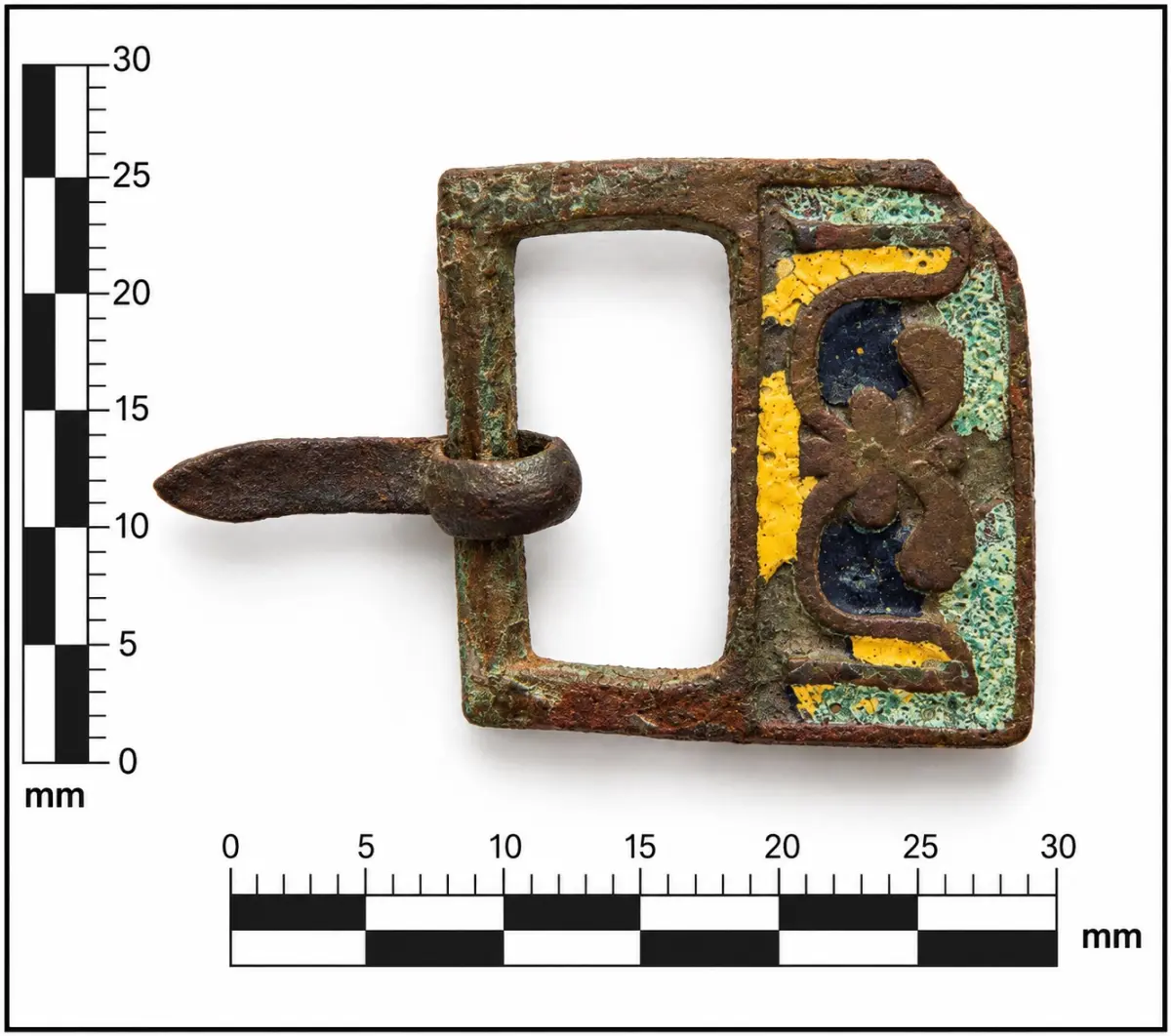
In the Tsetzin Forest near Chernivtsi, local residents found metal artifacts dating back about 1,800 years. These may be parts of a Roman belt set that, according to one theory, belonged to a Sarmatian horseman, Blik reports.
The finds were discovered during historical and ethnographic research conducted as part of the RESTORY project under the EU’s “Horizon Europe” program. Local residents handed them over to Professor Antony Moisey of Bukovina State Medical University, who has been researching the heritage of the Rosha neighborhood since 2024. The most valuable items are a 21 × 22 mm buckle and a decorative belt plate, both adorned with colored cloisonné enamel. Three round metal plaques, likely from the same set, were found nearby, according to the BSMU website.
The people who found these small metal objects did not consider them valuable. In an interview with the publication “Molodyi Bukovynets,” the historian explained why he took notice of them, ZAXID.NET reports.
“Today, enamel or colored glass seem like ordinary materials. But nearly two thousand years ago, making such items was a highly technical endeavor. It was precisely the multicolored enamel preserved on the objects that served as the first indication that the finds might be significantly older and more interesting than they initially appeared,” said Antony Moisey.
A Roman artifact and a Sarmatian trace
Moses compared the finds with archaeological materials from Ukraine, Moldova, Romania, and the former Roman provinces. The closest analogues date to the 2nd–3rd centuries CE and were found in Roman Dacia, which encompassed mostly modern-day Romania. Previously, a silver coin of Emperor Trajan and fragments of ancient amphorae had already been discovered at Rosha.
The place where the items were made does not necessarily indicate who their owner was. In the 2nd–3rd centuries, the Sarmatians had contact with the Roman Empire, and archaeologists find Roman jewelry, tableware, and pieces of equipment in their graves.
“There is a theory that these are the belongings of a Sarmatian warrior from Tsetzyno. This theory is supported by the time period, the region, the prevalence of Roman artifacts among the Sarmatians, and the great importance of belt and horse gear among horsemen. We also reviewed published materials on the Carpathian Tumulus Culture and the Chernyakhov Culture, but have not yet found a close analogue to this enameled buckle,” noted Moses.
The research is ongoing. Once it is completed, the artifacts are to be transferred to the Chernivtsi Regional Museum of Local History.