
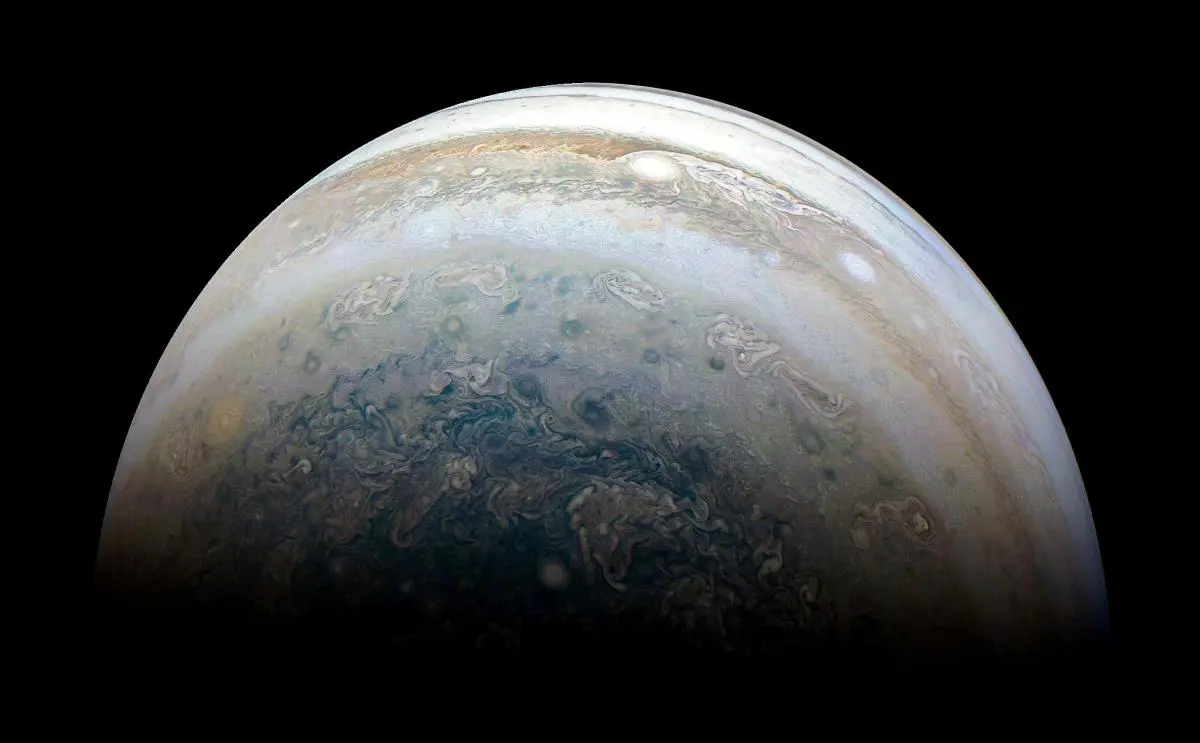
On the morning of Sunday, November 15, Mars and Jupiter will come within about 1.2 degrees of each other in the sky, and the pair will be easily visible to the naked eye. At 5:30 a.m. local time, both planets will be so high above the southern horizon that, under clear skies, they will be visible even from a south-facing window, according to Rakéta, citing the Hungarian Svábhegyi Observatory.
Jupiter, with a magnitude of –2.1, will be a noticeable speck near Regulus, the brightest star in the constellation Leo, at an altitude of 56 degrees. Above it will be reddish Mars, with a magnitude of 0.7. Regulus is visible 4.4 degrees to the left of Jupiter. The planets will be clearly distinguishable by color: Jupiter is whitish, Mars is orange-red, and Regulus is bluish-white.
If it is cloudy on November 15, the pair can also be observed on the days before and after. On November 14, the planets will be 1.4 degrees apart, and on November 16, they will be 1.2 degrees apart again. They can be observed until the onset of civil twilight. Through binoculars, Jupiter appears as a tiny disk with its Galilean moons, while Mars, due to its small size, still resembles a star.
A Rare Pair in the Morning Sky
The formal conjunction of the planets will occur on November 15 at 11:00 a.m. Philippine Time, when the angular separation between them will be 1°15'. Mars and Jupiter will come closest to each other the following day, to within 1°11'. Both events occur during daylight hours, so it’s best to observe the pair in the morning. In addition, starting November 12 at dawn, you can see a parade of five planets: Mercury, Venus, Jupiter, Mars, and Uranus, according to the Philippine agency PAGASA.
Conjunctions between Mars and Jupiter occur on average once every 2–2.5 years, because Mars orbits the Sun faster and “catches up” to Jupiter. Close approaches are much rarer: in 1761, the planets came so close together that to the naked eye they appeared as a single point of light. This time, the distance between them at arm’s length will be roughly equal to the width of a little finger, according to the Royal Observatory Greenwich.
Bruce Betts, chief scientist at the Planetary Society, advises looking for the planets between about 4:00 and 6:00 a.m. in a location where the eastern part of the sky is not obstructed by trees or mountains. According to him, such a conjunction occurs only once every few years.
Betts believes that the planetary conjunction deserves more attention than the full moon on November 23–24, when the Moon will be closest to Earth.
“The supermoon gets much better publicity than planetary alignments,” Betts emphasizes.