
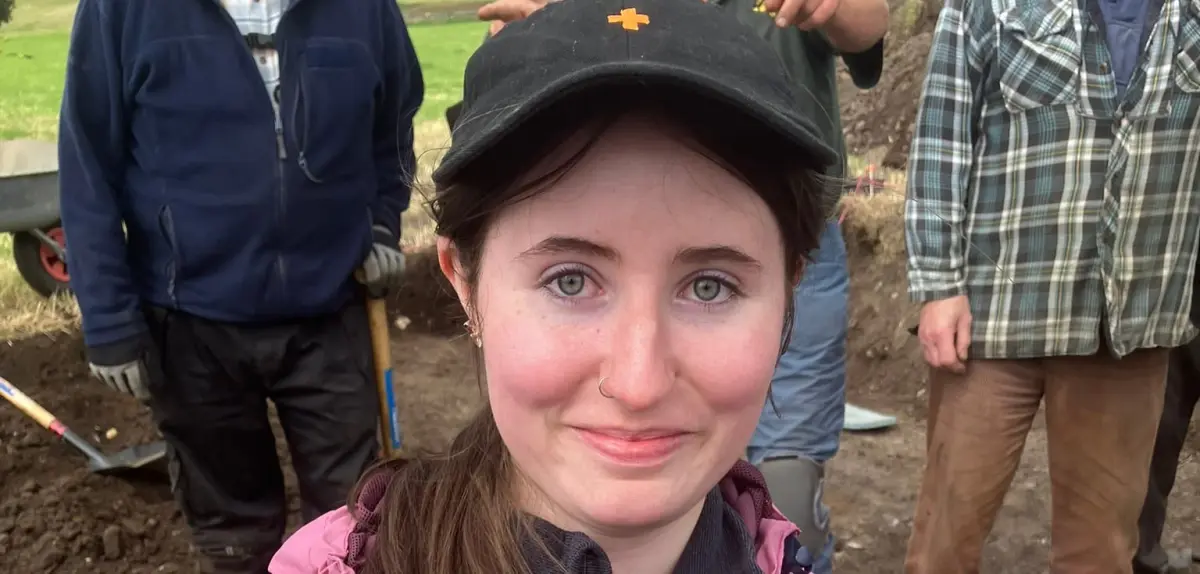
Elise Zallu, a first-year archaeology student at Newcastle University, found a fragment of a Roman gold chain nearly 2,000 years old on her first day of excavations. The discovery was made in the Redesdale Valley in Northumberland, in northern England, where the northern border of the Roman Empire once ran, according to Welt.
Prior to this, Zall had never participated in fieldwork. Her trowel struck a small, shiny object during a training excavation.
“Finding the gold chain was truly surreal, especially considering that it was the first day of my very first excavation. I never expected to find anything like this in my entire career, so it was definitely a surprise,” Zallu said.
The chain, about 7 cm long, is so well-preserved that, if it were intact, it could still be worn today. It was crafted using the intricate “loop-to-loop” technique: the rings were compressed into a figure-eight shape, bent, and intertwined. Such items were made from very pure gold and were associated with the jewelry of the elite, military amulets, or the regalia of high-ranking officers and their families, according to Newcastle University.
“Finding a gold artifact is something many archaeologists may never experience in their entire careers. The fact that a freshman discovered a beautifully preserved Roman gold chain on her very first day at the excavation site is truly impressive,” emphasizes Eric Tourigny, a lecturer at the university’s School of History, Classics, and Archaeology.
A lead inscription and a seal featuring Jupiter
The excavations in the summer of 2026 were part of a long-term project to study the infrastructure of the northern Roman frontier. Fifty-two first-year students, divided into two groups for two-week stints, participated alongside volunteers from a local archaeological group. The quantity and quality of the finds surprised even experienced researchers.
On that very first day, student Shannon Wood found a folded sheet of lead bearing traces of Latin cursive. It may be a commercial seal or a so-called “curse tablet”; the inscription is still being studied. The next day, Megan Potter unearthed a gilded bronze crescent-shaped pendant from a cavalry rider’s gear, indicating the owner’s high status.
In the final week of the season, Maisie Watmore and Zoe Yule discovered a carnelian intaglio—a carved signet stone depicting Jupiter holding a scepter, with a figure of Victoria and an eagle at his feet. This is the fourth such find at the site.
Other artifacts include coins, spearheads, clothing accessories, and pottery with graffiti. The name “MARTIN” or “MARTINUS” is scratched onto one of the bowls and several other fragments—presumably the markings of an owner who lived or worked here nearly 2,000 years ago, according to The Independent.
Excavation director Richard Carlton is convinced that the value of the finds lies not only in their quality but also in the stories behind them.
“A gold chain, a gem-set seal, inscribed pottery, and an ornate brooch shed light on the lives of the people who kept this place running nearly two millennia ago. Together with the buildings and production facilities the team is excavating, they also help us understand how the frontier functioned and how Roman and local communities interacted,” Carlton said.