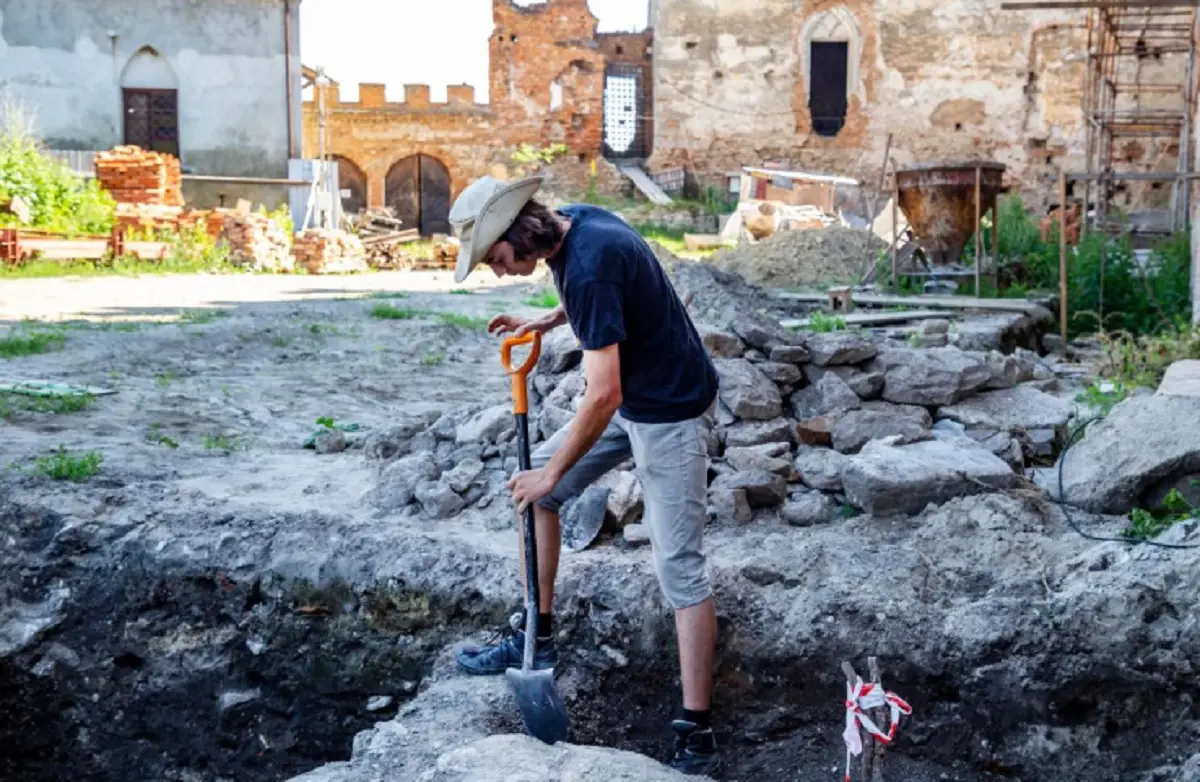
First-year students at Newcastle University discovered a treasure from the Roman Empire, dating back about 2,000 years, in the British county of Northumberland during their first archaeological excavation. The number of artifacts and their condition surprised even experienced researchers, according to G4Media.
The most valuable find is a fragment of a gold chain about 7 centimeters long. It is so well-preserved that, if it were intact, it could still be worn today. Such jewelry was crafted using the intricate “loop-in-loop” technique and typically belonged to the Roman elite, serving as military amulets or accessories for high-ranking officers and their families.
The excavations took place in the summer of 2026 in the Redesdale Valley. Fifty-two students participated, working in two groups for two weeks each alongside volunteers from the local archaeological society. The necklace was found on the very first day by student Elise Zallu, according to a statement from Newcastle University.
The freshman doesn’t hide her excitement about what happened right at the start of the field season: “Finding the gold necklace was truly surreal, especially considering it was the first day of my very first excavation. I didn’t expect to find anything like this in my entire career, so it was definitely a surprise,” Zallu said.
For professional archaeologists, such finds are extremely rare. “Discovering a gold artifact is something many archaeologists may never experience in their entire careers. The fact that a freshman discovered a beautifully preserved Roman gold chain on her first day at the excavation site is truly amazing,” emphasized Eric Tourigny of Newcastle University, as quoted by The Independent.
Lead with Latin Inscription and a Gilded Cavalry Ornament
On that same first day, student Shannon Wood found a folded piece of lead bearing traces of a Latin inscription. Archaeologists speculate that it is a seal related to trade, taxes, or supplies for the Roman army. Another possibility is that it was a tablet bearing a personal message, a prayer, or a curse.
On the second day, Megan Potter discovered a bronze crescent-shaped pendant that would have been attached to a military belt, horse harness, or sword scabbard. Despite corrosion, much of the gilding has been preserved. Scientists believe the item may have belonged to a cavalry officer. Other finds include coins, spearheads, and pottery, including several shards with the name “Martinus” scratched into them.
Jupiter on a Carnelian
Toward the end of the season, students Meizi Watmo and Zoe Yuell discovered an intaglio—a carnelian seal stone depicting Jupiter holding a scepter, with a figure of Victory and an eagle at his feet. This is already the fourth such find at this site: two were discovered in 2025, and another in the 19th century.
The researchers see the treasure’s value not only in the materials or the craftsmanship. “These finds are fascinating not only for their quality but also for the stories they tell. A gold chain, a signet gem, inscribed pottery, and a decorated brooch shed light on the lives of the people who kept this place running nearly two millennia ago,” notes excavation director Richard Carlton. According to him, together with the uncovered buildings and industrial structures, the artifacts help us understand how the empire’s northern border functioned and how the Romans interacted with local communities.