
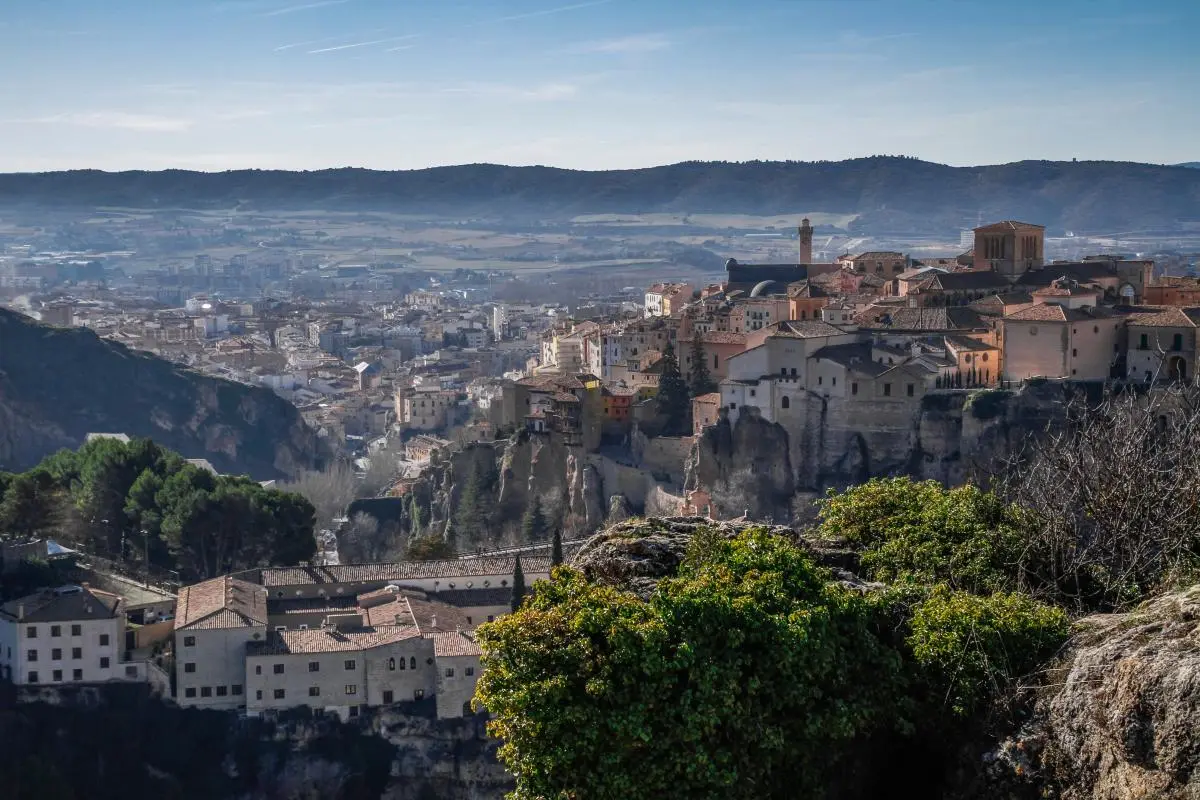
From Madrid, it’s easy to reach the little-known Spanish city of Cuenca, famous for its “hanging houses” above a gorge. The city is being promoted as an alternative to Barcelona, Madrid, and Seville, according to the Daily Mail.
Cuenca is located in the mountains of the autonomous community of Castile-La Mancha, south of Madrid. The nearest airport is Madrid’s Adolfo Suárez Barajas, from which the city is an hour and a half by train or an hour and forty minutes by car. Hotel rooms can be booked starting at 40 pounds per night. Prices are current as of November 16.
The city’s main attraction is the casas colgadas, Gothic-style houses with tall windows and wooden trim that hang over the Uecar River. They were built between the 13th and 15th centuries, though only three are open to visitors today. One, the Casa de la Sirena, houses a restaurant, while the other, the Casas del Rey, is home to the Museum of Spanish Abstract Art. According to the Spanish Tourism Board, the best view of the houses is from the San Pablo iron pedestrian bridge.
Nearby stands a 12th-century cathedral, and among the local dishes, travelers are advised to try ajoarriero—cod with garlic, tomatoes, and peppers—and morteruelo, a pâté-like ragout. According to the Association of British Travel Agents, Spain remains the most popular destination for residents of the United Kingdom.
A UNESCO-Protected Fortress
The historic fortress city of Cuenca, located 170 km southeast of Madrid, is a UNESCO World Heritage Site. It was founded by Muslim rulers on the outskirts of the Caliphate of Córdoba, and in the 12th century, the city was conquered by the Castilians. The local cathedral, built on the site of the former Great Mosque, is considered the first Gothic cathedral in Spain. Most of the “hanging houses” were rebuilt in the 16th century, giving them their current narrow and tall shape. According to UNESCO, the organization cites tourist pressure, commercial activity in public spaces, and traffic as the main threats to the old city.
It is not known for certain why medieval residents built their homes right on the edge of the cliff: some historians attribute this to a desire to make use of every meter in a city hemmed in by cliffs. The Museum of Abstract Art, located in one of the buildings on Canonigos Street, was founded in 1966 by artist Fernando Sobel; it exhibits works by Antoni Tàpies and sculptures by Eduardo Chillida, according to the Los Angeles Times.