
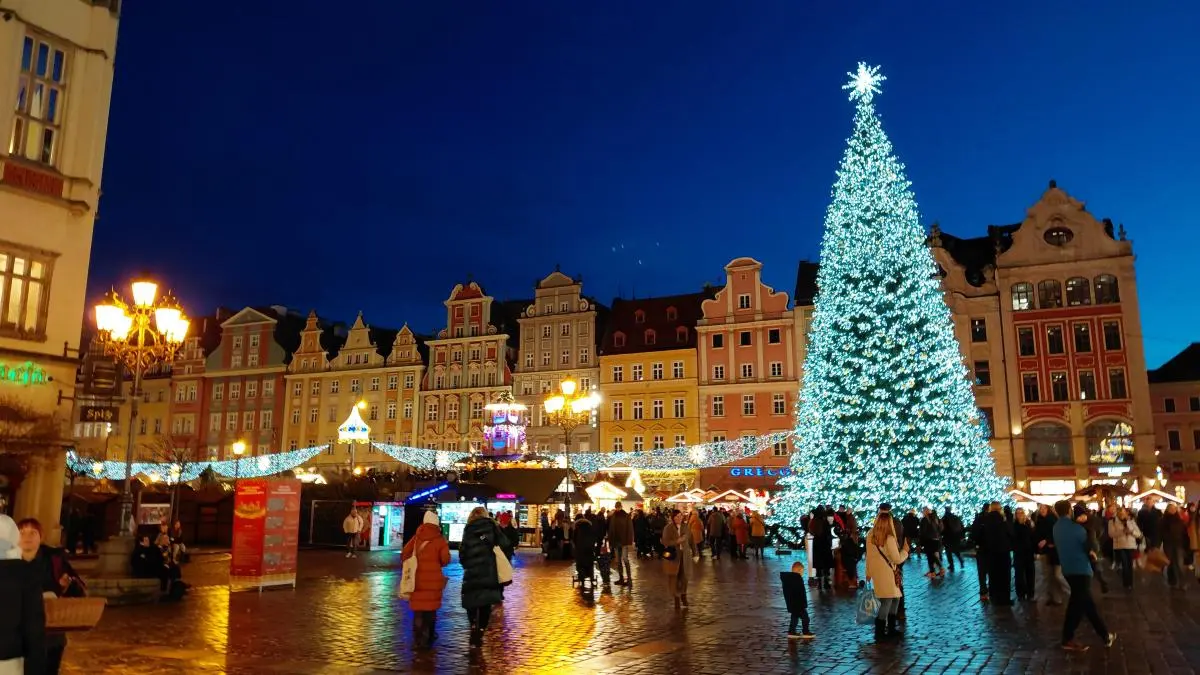
Wrocław, Poland’s third-largest city, is recommended by an American travel publication as an alternative to Germany’s crowded and increasingly expensive Christmas markets. This year’s market in the city will run for nearly seven weeks, from November 20, 2026, to January 7, 2027, according to Travel Off Path.
The market is open daily from 10:00 a.m. to 9:00 p.m., and admission is free. It will be closed on December 24–25 and January 1. Last year, the city set up about 260 stalls, twice as many as at the famous market near Cologne Cathedral. The festive venues are not limited to Market Square; they also include Salt Square, Świdnicka Street, and Olavska Street.
This year, Wrocław is stepping up security measures at the market. The publication attributes this to the shooting in Kraków, which shook the country. At the same time, the U.S. State Department maintains the first, lowest risk level for Poland.
Over a million visitors per season
The previous, 18th fair was attended by 1,025,887 people, which is 26% more than the previous season (812,389). Over 60% of visitors were residents of Wrocław. These figures were provided by city authorities, citing research by mobile operators, according to Wrocław’s official website.
City officials are convinced that the event attracts not only city residents but also visitors from other regions and abroad.
“A significant group of visitors—nearly 40 percent—are people from outside our city, including residents of Lower Silesia (13 percent) and other regions of Poland (16.3 percent). One in ten visitors to the Christmas market comes from abroad. These figures show that the market truly generates tourist traffic,” emphasizes Radosław Michalski, director of the city’s branding department.
Last season, 230 vendors from Poland and other European countries sold their goods at the market. Over 70% of them were entrepreneurs from Lower Silesia.
A Tradition Dating Back to the 16th Century
The first historical mention of the Christmas market in Wrocław dates back to 1566. According to Professor Joanna Nowosielska-Sobel of the Institute of History at the University of Wrocław, religious items typical of Christmas were already being sold there as early as the 17th century, and gingerbread appeared on the stalls from the very first fairs, according to the University of Wrocław.
Due to its proximity to the western border, the fair has a distinctly international character. Alongside Polish dishes and glintwein-gżanec, German and Czech delicacies are also offered here, according to the Polish Tourist Organization.