
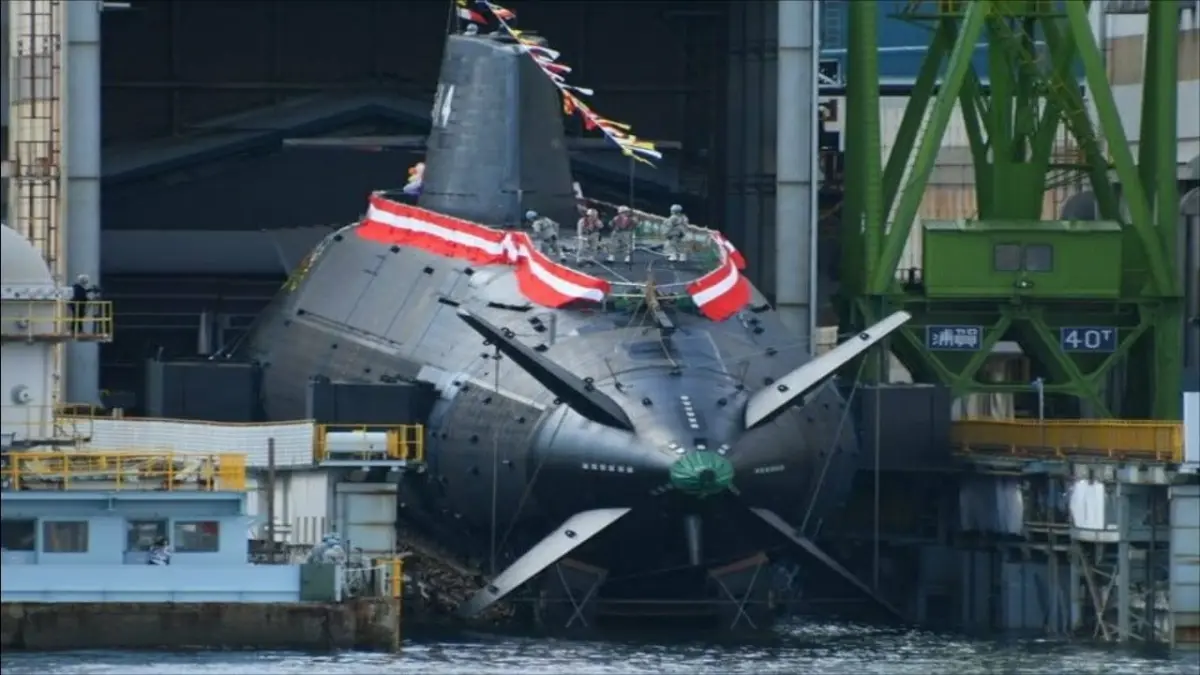
Japan’s new “Taigei”-class diesel-electric submarines have completely abandoned Swedish anaerobic Stirling engines in favor of lithium-ion batteries. Japan initially tested this technology on the last two submarines of the previous “Soryu” class and now plans to build a fleet of ten new submarines to counter the growth of the Chinese Navy, according to 19FortyFive.
The lead vessel of the series, the “Taigei,” joined the Japan Maritime Self-Defense Force in 2022. Since then, the fleet has been expanded by one vessel each year. The publication’s columnist, Isaac Seitz, considers these submarines to be among the most advanced non-nuclear attack submarines in the world.
“I think the Taigei class can be described in one word: power,” Seitz concludes.
Batteries Instead of Oxygen
The Stirling engines from the Swedish company Kockums, installed on the “Soryu,” burn diesel fuel with liquid oxygen and allow the submarine to remain submerged for longer periods. However, the Japanese military found that such systems produce significantly less energy, which limits speed and increases charging time. Lithium-ion batteries store nearly twice as much energy as lead-acid batteries, and the space freed up by removing the engines allowed for the installation of additional batteries.
At the same time, the use of lithium-ion batteries in the submarine fleet remains extremely limited: in the event of a malfunction or fire, they can release hydrogen and become extremely hot. Japan has learned to manage these risks through a research and testing program that has been ongoing for more than 20 years. The “Taigei” has a maximum underwater speed of 20 knots and a crew of about 70, according to Proceedings.
GS Yuasa supplies the batteries for the new submarines, and Japan has become the first country to successfully implement this technology. Former Japanese Navy Commander Kazuki Yamashita also highlights other design innovations, according to USNI News.
“One of the distinctive features is the use of a floating deck, which reduces noise and improves impact resistance,” Yamashita emphasizes.
A Response to the Growth of the Chinese Navy
The “Taigei” has a surface displacement of 3,000 metric tons and a length of 84 meters. Its primary armament consists of Type-89 heavy torpedoes and Sub-Harpoon anti-ship missiles. According to some reports, the submarines may eventually be equipped with Type 12 cruise missiles with a range of about 200 km.
Currently, Japan has 22 diesel-electric submarines, while China has about 48, not counting approximately 60 nuclear-powered attack submarines. The 1954 Self-Defense Forces Act prevents Tokyo from significantly expanding its fleet, so the country is relying on a small but technologically advanced submarine fleet.