
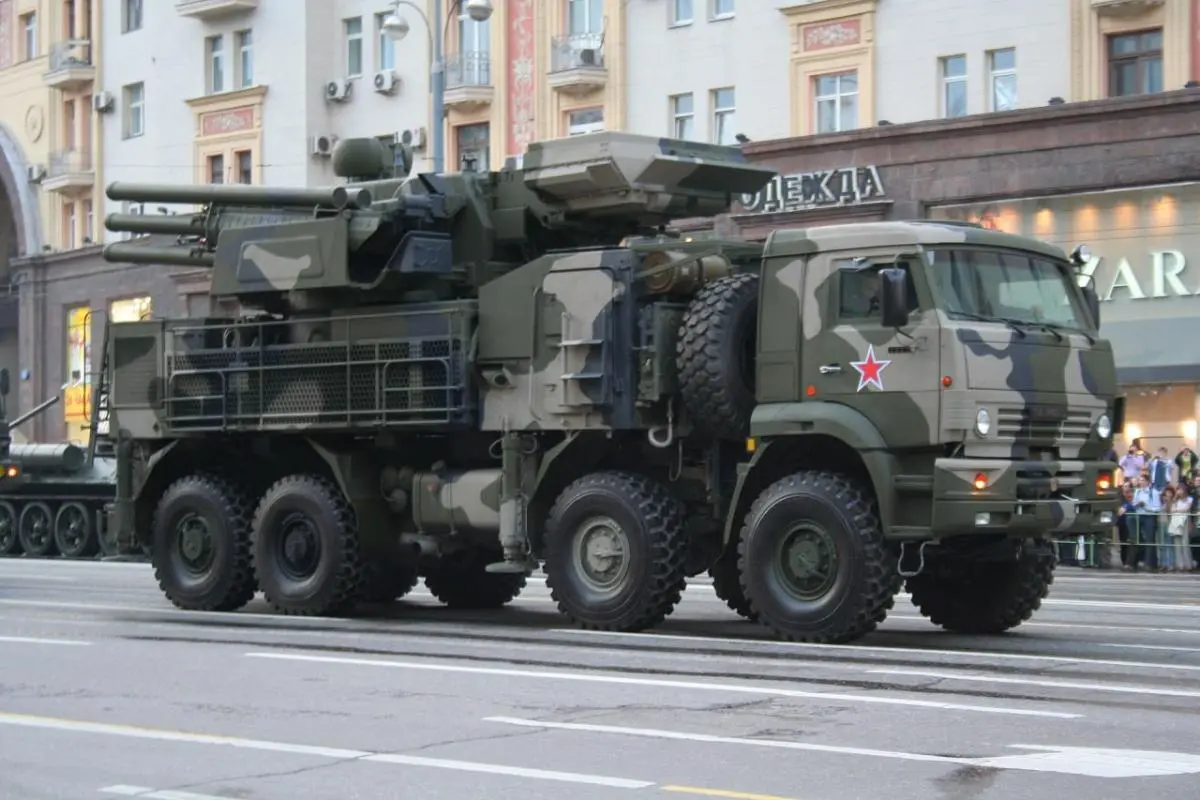
Russia hopes to conclude an agreement to sell "Pantsir-S1" anti-aircraft missile and gun systems to Azerbaijan. Dmitry Shugaev, director of the Russian Federal Service for Military-Technical Cooperation, made this statement on November 1 during a broadcast on the Russian state-run military television channel “Zvezda.” According to him, the system is in high demand among foreign customers, and Moscow and Baku will reach an agreement on deliveries in the near future, reports Defence Blog.
Shugaev did not specify how many systems Baku might purchase, what the contract value would be, or whether official negotiations had begun. Azerbaijan has not commented on this statement.
In the same interview, Shugaev stated that the countries had signed a program under which Russia will assist in building and modernizing facilities for the repair of armored vehicles already in service with the Azerbaijani army. In the 2000s and 2010s, Baku purchased about 100 T-90S tanks from Russia, as well as roughly the same number of BMP-3 infantry fighting vehicles and BTR-80A armored personnel carriers.
The “Pantsir-S1” mounts anti-aircraft missiles and twin 30-mm cannons on a single chassis. It is designed to protect facilities from aircraft, helicopters, cruise missiles, and drones. The export version can engage targets at ranges of up to 20 km and altitudes of up to 15 km.
The Downed Plane and a Year of Strained Relations
Relations between Moscow and Baku deteriorated sharply after Russian air defense forces shot down an Embraer E190 passenger plane operated by Azerbaijan Airlines on December 25, 2024. The plane crashed near Aktau, Kazakhstan; 38 of the 67 people on board were killed. Azerbaijan demanded that Russia accept responsibility and threatened to file international lawsuits, and President Ilham Aliyev did not travel to Moscow for the May 9 celebrations in 2025.
In October 2025, Russian President Vladimir Putin acknowledged that the crash was caused by a malfunction in the Russian air defense system and promised to pay compensation. In April 2026, the foreign ministries of both countries stated that they had resolved all issues related to the crash and pledged to develop “allied” cooperation.
In the days immediately following the tragedy, the pro-government Azerbaijani television channel AnewZ reported that, according to preliminary findings of the investigation, the plane had been struck by debris from an anti-aircraft missile fired by the “Pantsir-S” system. At the time, the Kremlin urged people not to put forward “hypotheses” until the investigation was complete, according to the BBC.
Turkish Weapons and a Domestic Equivalent
In recent years, Azerbaijan has been purchasing modern weapons primarily from Turkey and Israel. On September 30, at the ADEX 2026 exhibition in Baku, the country signed contracts with Turkish companies worth over $500 million. In Israel, according to the publication Globes, Baku ordered PULS multiple-launch rocket systems and missiles for them from Elbit Systems worth $235 million.
At the same exhibition, Azerbaijan demonstrated its own CWS-30GD Viking short-range air defense system, developed jointly with the Czech company CSG. It combines a radar, an optoelectronic system, electronic warfare capabilities, a 30-mm cannon, and anti-aircraft missiles mounted on a Tatra chassis; like the “Pantsir-S1,” it is primarily designed to counter drones and low-flying targets, according to Army Recognition.
At the same time, according to the Oryx project, Russia has lost at least 54 “Pantsir” systems in the war against Ukraine. The Security Service of Ukraine has identified these systems as a priority target for its long-range drone units.