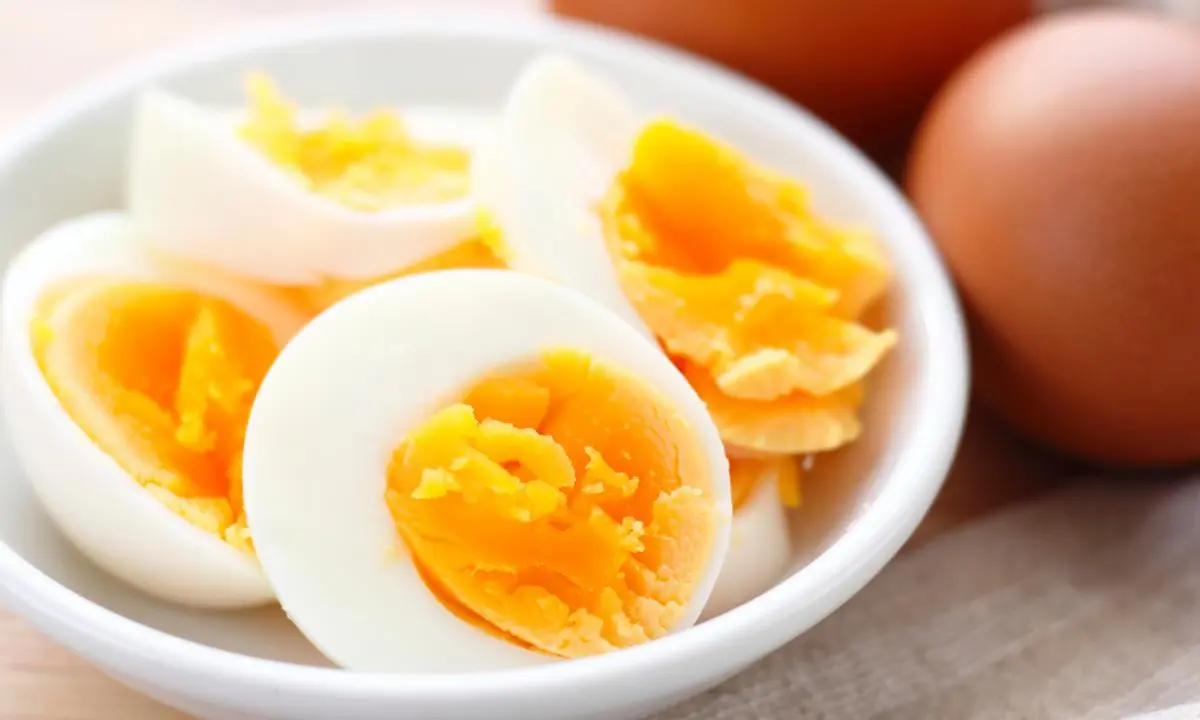
A teaspoon of baking powder added to boiling water before adding the eggs makes it much easier to peel the hard-boiled eggs. This tip was shared on Instagram by food blogger Kerry Welpdale, and if you don’t have baking powder, you can substitute baking soda, according to Vince, citing the Mirror.
The process is simple: first, bring the water to a boil, then stir in the baking powder, and only then carefully lower the eggs into the water. The publication also recommends using eggs that are a few days old and, immediately after boiling, submerging them in ice water so that the shells come off more easily and the whites remain intact.
The age of the egg matters
The importance of freshness is also confirmed by long-standing research. As early as 1989, scientists at the University of Georgia determined that how easily an egg peels depends on the acidity of the raw egg white: eggs with a pH above 8.9 peel without any problems. The warmer the eggs are stored, the faster the pH rises. According to an article in the journal *Poultry Science*, this requires at least one day at 38 °C, three days at 24 °C, or five days in the refrigerator at 4 °C.
A Hot Start and an Ice Bath
At the same time, the chefs at Milk Street are skeptical of these life hacks. The publication’s digital editor, Claire Lower, emphasizes that neither pricking the shell, nor using old eggs, nor adding baking soda to the water works as well as placing the eggs directly into hot water, Milk Street reports.
According to her, eggs placed in cold water heat up gradually, and the egg white adheres to the membrane inside the shell. A sudden temperature change, on the other hand, causes the egg white to separate from it.
The other half of the secret lies in what happens to the eggs after they’re cooked. Milk Street founder Christopher Kimball said he revised his approach after a trip to Paris.
“J. Kenji López-Alt convinced me that the secret to easy-to-peel eggs is steaming. However, a meeting with Chef Christopher Edwards shifted my focus to cooling. He demonstrated that the key is a large ice bath, which quickly cools the hot eggs so that the whites contract and separate more easily from the shells,” Kimball wrote.
For four eggs, he recommends at least one ice cube tray and two glasses of water; for twelve, three times as much. The eggs should be completely submerged for three minutes. Cooling them under cold running water also helps, but, based on his observations, it’s much less effective.
Milk Street also provides a guide to cooking times: 6–6.5 minutes yields a runny yolk, 8.5–9 minutes yields a medium-done yolk, and 12.5–13 minutes yields a hard-boiled egg.