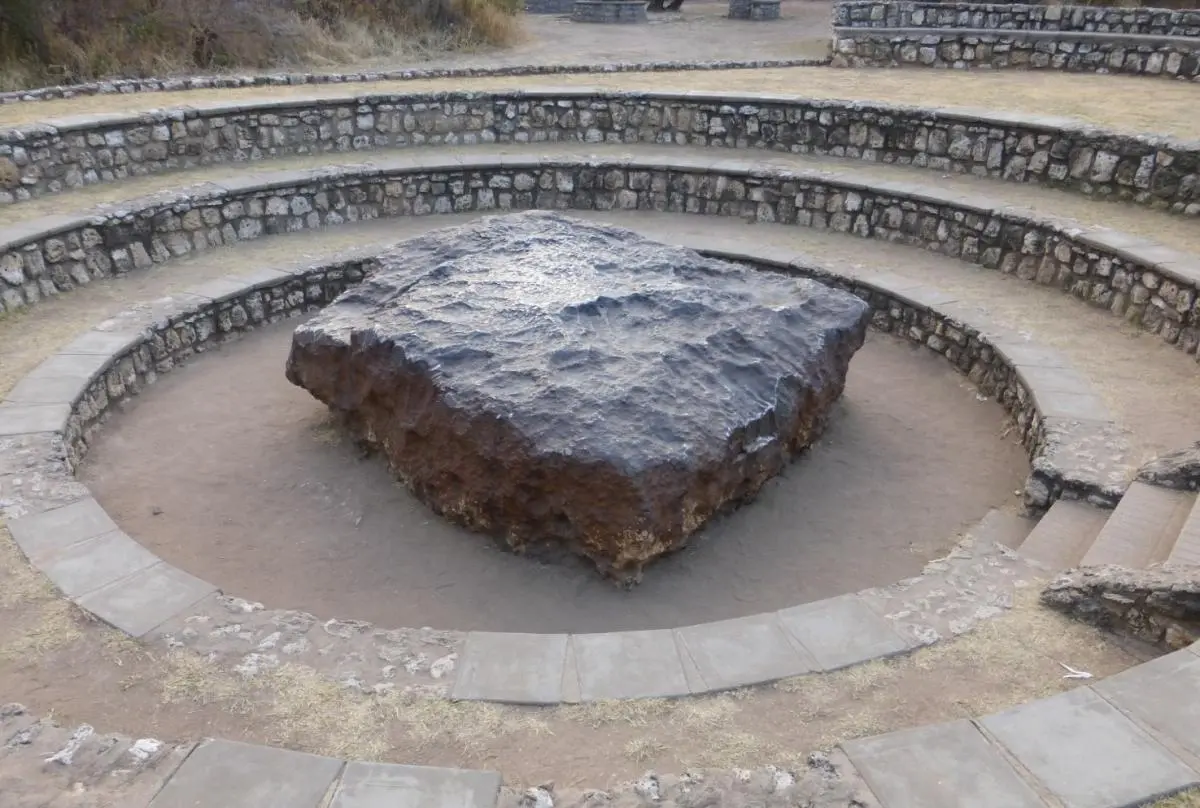
Meteorites that look no different from ordinary rocks found in fields, forests, or on the side of the road can be worth more than gold. The price of the rarest specimens from Mars and the Moon reaches about 5,000 euros, or approximately 21,500 zlotys per gram, according to WP Tech.
Such prices are not the norm for all space rocks. Unclassified meteorites from the Sahara sell for about 2 zlotys per gram, while fragments from well-documented falls, such as the Russian Sikhote-Alin, cost 7–11 zlotys per gram.
A record-breaking example is the Martian meteorite NWA 16788, weighing 24.67 kg, found in the Sahara in 2023. It is considered the largest fragment of Mars on Earth. In July 2025, Sotheby’s auction house sold it for $5.3 million, or about 19.4 million zlotys.
What Determines the Price of a Space Rock
Collectors consider which celestial body the specimen originated from, what minerals and elements it contains, and whether its extraterrestrial origin can be confirmed. Size, mass, and condition are also important factors. Water and weathering erode the surface, so well-preserved meteorites are the most sought after.
A clue may be a 1–2 mm-thick crust formed as the stone passes through the atmosphere, as well as indentations resembling fingerprints—regmaglypts. About 95% of meteorites contain iron and nickel and are attracted to a magnet, but this alone is not enough to confirm their nature: some terrestrial rocks have similar properties, so expert analysis is required.
The story of the Winchcombe meteorite, which fell in England in 2021, illustrates why time is of the essence. Scientists organized a search as quickly as possible to prevent the fragments from becoming contaminated or damaged, according to the Natural History Museum.
“This type of meteorite reacts very quickly with the atmosphere. As soon as it passes through it, it changes. A fusion crust forms on it, which is why it is very black and shiny around the edges. As soon as it hits the surface, all the minerals and elements inside begin to react with moisture in the air,” explains Ashley King, a meteorite specialist at the Natural History Museum in London.
Finding one doesn’t mean keeping it
Meteorites fall not only in deserts but also in fields, meadows, and on private property. In 2025, a specimen weighing about 93 g was found in the Lublin region of Poland.
The trade in meteorites is permitted in Poland, but the circumstances under which they were found matter. According to Article 181 of the Civil Code, ownership of an ownerless object can be acquired by taking it into one’s own possession—this is the interpretation offered by Andrzej Kotowiecki, a retired prosecutor and co-founder of the Polish Meteorite Society. The finder becomes the owner if they searched with the written consent of the landowner. However, if the land was damaged during the search—for example, by deep excavations—the owner may assert their rights in court.
A metal detector does not grant the right to search any area: depending on the territory, permits are required, and separate rules apply near archaeological sites. Exporting a meteorite from Poland may require permission from the Director General for Environmental Protection.
Poland has already experienced large-scale meteorite falls. On January 30, 1868, one of the largest meteorite showers recorded at that time occurred near Pultusk: according to eyewitnesses, tens of thousands of stones fell, from which over 250 kg were collected, reports the Buseck Center for Meteorite Studies.