
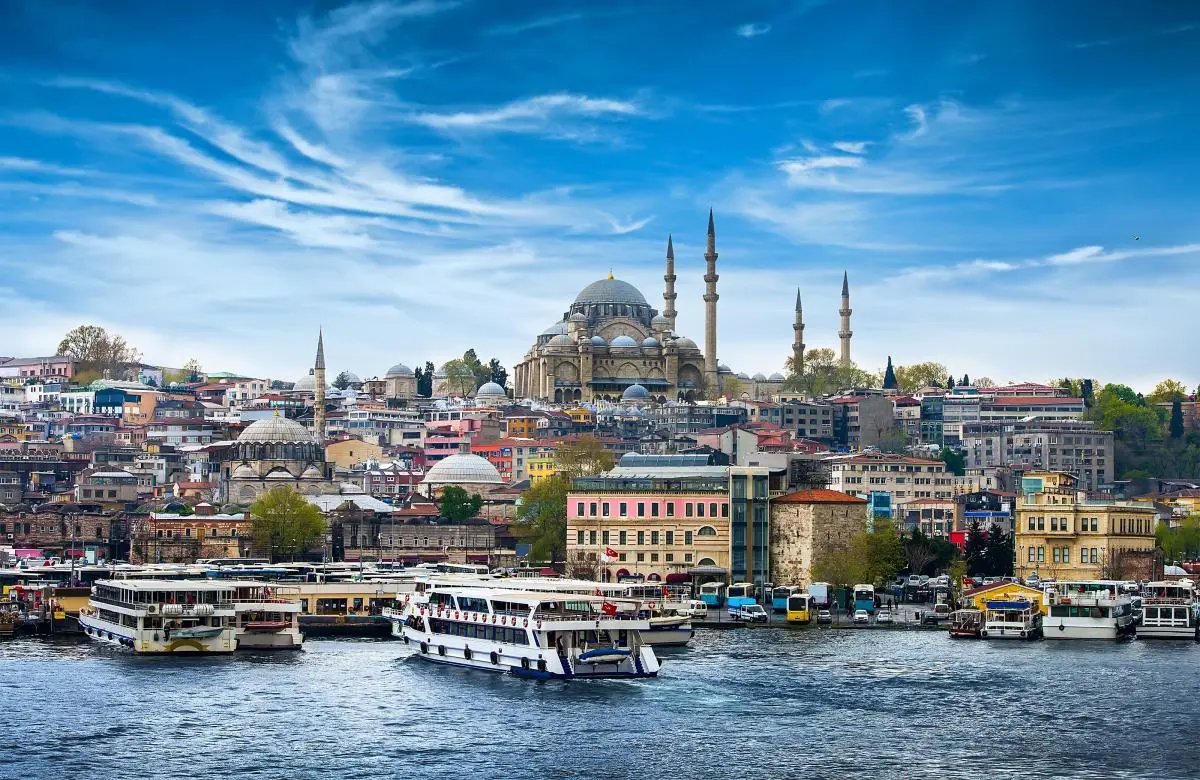
Archaeologists have discovered a previously unknown underground network consisting of six chambers and nine tunnels beneath the Hagia Sophia in Istanbul. The total length of the galleries that have already been cleared is 420 meters. The discoveries were made during a large-scale restoration of the monument, which Turkish authorities call the largest project of its kind in the country’s history, according to Libertatea.
The results of the work were presented by Turkey’s Minister of Culture and Tourism, Mehmet Nuri Ersoy. He descended into the underground chambers together with researchers. Nearly 3,000 metric tons of soil and loose material were removed from two areas of the complex: the Vizier’s Garden and the Western Garden.
In the Vizier’s Garden, researchers stumbled upon an underground burial structure of the hypogeum type. The excavations reached one and a half meters below the former silt level and uncovered architectural layers that may predate the current building, which was constructed in 532–537 during the reign of Emperor Justinian. There is no precise dating yet, and the hypothesis of a pre-Justinian origin is still being verified.
Churches had stood on this site before. The first church was consecrated by Emperor Constantius in 360 and was destroyed during the riots of 404. The second, built in 415 during the reign of Theodosius II, was destroyed by fire during the Nika Revolt of 532, according to the ASCE.
Six chambers connected by nine tunnels were discovered in the Western Garden. According to Ersoy, three of the chambers likely belonged to the underground section of the ancient atrium—that is, the inner courtyard of the church complex. The width of some of the corridors ranges from 4 to 4.8 meters.
Constantinople’s Waterways
Seven tunnels have already been completely cleared of sediment, while topographic surveys are ongoing in the other two. The longest passage is 180 meters long and has a gradient of about 3%. It runs parallel to the facade from the Fatih Madrasa to the current visitor entrance. Researchers are investigating whether it was connected to an ancient Roman road. According to the researchers, the network was part of the historic city’s water supply system: it distributed water and drained rainwater, protecting the cathedral’s foundation.
Professor Hasan Fırat Diker, a member of the Hagia Sophia Scientific Committee, estimates the total length of the passages to be over one kilometer. He compares their structure to the circulatory system and describes his work as “clearing the cathedral’s arteries.”
“Inside the tunnels, we discovered terracotta water conduits. In many places, the passage is so narrow that you have to crawl. They were not intended for general passage but were designed for specialists who inspected and maintained the water channels,” Diker said in an interview with Hürriyet, according to Hürriyet Daily News.
Will Tourists Be Allowed Underground?
At the same time, restorers are reinforcing the masonry, restoring the vaults, and installing stainless steel reinforcement. In one of the 56-meter-long chambers, damage has already been repaired over an 18-meter section. The government is considering the possibility of including part of the underground complex in a tourist route. Ersoy promised to develop a separate concept for presenting the site, but emphasized that preserving the monument and ensuring visitor safety remain the top priorities. The minister did not specify a date for the opening.
Dicker suggests that access may be organized through quotas and advance reservations to avoid crowds. “Not all areas are suitable for visitors, but there are large underground sections with open access that will be open to the public,” the scientist emphasized.