
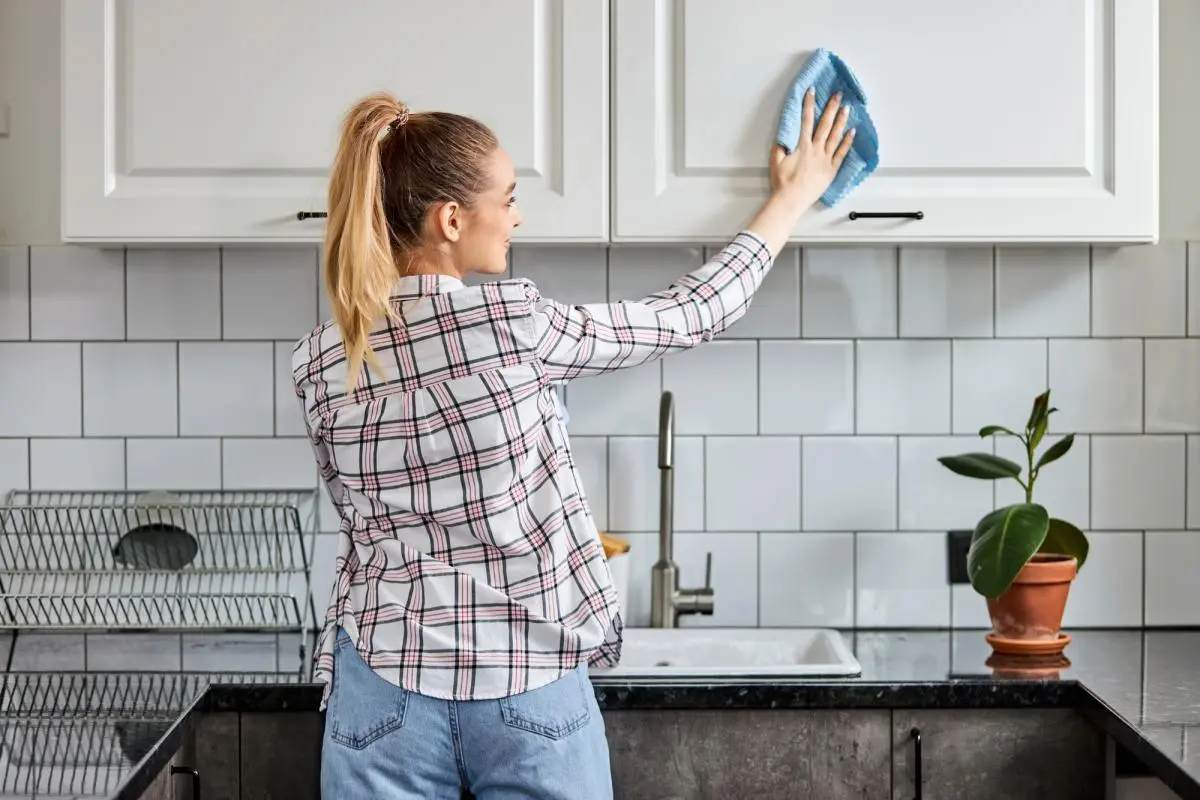
Three or four drops of dish soap per liter of warm water are enough to remove greasy residue from kitchen cabinet fronts. Apply the mixture with a spray bottle, wipe it down with a soft cloth, and dry it immediately, according to Deccoria.
This buildup occurs during cooking: tiny particles of grease settle on nearby surfaces, and dust sticks to the sticky layer. Over time, dirt penetrates the pores of the finish, causing the cabinet fronts to yellow or lose their shine.
A dish soap solution is suitable for smooth, protected surfaces made of laminate, varnish, or acrylic. It’s best not to use it on untreated, waxed wood, or veneer, as it may leave light-colored stains. More stubborn grime can be removed with a mixture of 125 ml of vinegar, 3–4 drops of dish soap, and one liter of water, left to sit for 2–3 minutes. This solution is suitable for laminate and PVC film, but not for wood or acrylic; moreover, a strong vinegar solution can cause white surfaces to yellow.
The authors advise avoiding metal sponges, not leaving moisture at the joints of laminate flooring, and not washing cabinets with boiling water: a sudden temperature change can cause microcracks in the lacquer finish. They recommend using water at room temperature.
An American expert recommends otherwise
Derek Christian, co-owner of All Star Cleaning Services, also told The Spruce that dish soap is the best choice. He explains that the surfactants in dish soap have one part of the molecule that binds to grease, while the other part is attracted to water.
“Imagine that a drop of oil is surrounded by these particles, and their heads now want to be with the water. When you pour out the water, the oil goes with it,” Christian notes.
However, when it comes to heating, the expert’s position is the opposite of Polish recommendations.
“You should use the hottest water you can tolerate. Oils are solid at room temperature and usually liquid when the temperature is higher. The hotter you clean, the more you turn the grease into a liquid instead of scrubbing it off,” Christian emphasizes.
He advises soaking a cloth in soapy water, applying it to the stain for a few minutes, and then rinsing it off with clean water. Particularly stubborn grease on wooden cabinets can first be warmed with a hair dryer. A steam cleaner, according to the expert, can melt plastic cabinet fronts.
“The harder you scrub, the greater the chance that you’ll wear away the finish,” Christian warns. That’s why he advises against using stiff brushes, abrasive sponges, and melamine sponges. Both sources recommend first testing the chosen cleaning product on an inconspicuous area of the cabinet.