
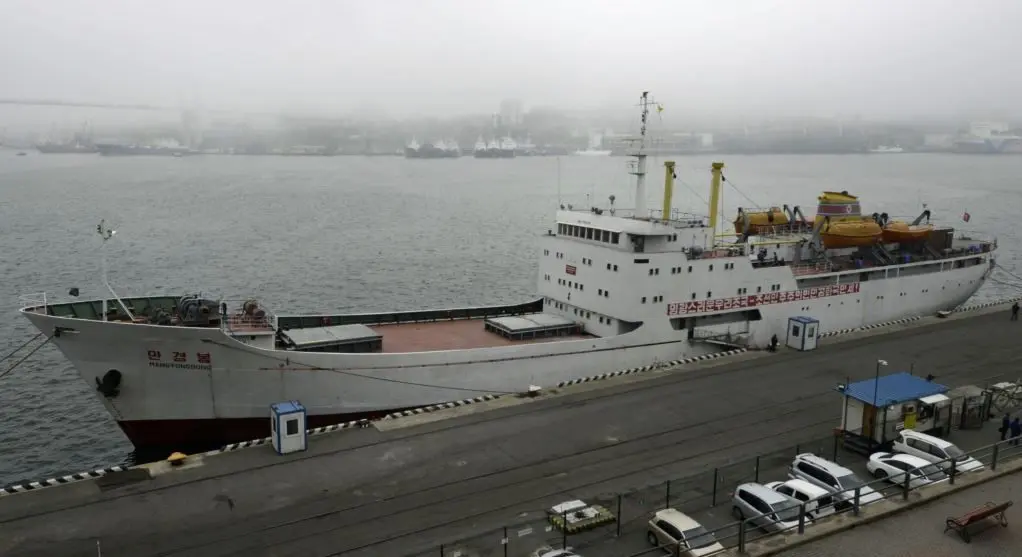
Russia will spend 47 billion rubles (about $576 million) on the construction of two rail ferries that will ensure an uninterrupted supply to the Kaliningrad exclave. This was announced on Monday, November 23, by Russian Prime Minister Mikhail Mishustin, according to HotNews, citing Reuters.
The ferries are scheduled to enter service in 2030. They will operate between the port of Ust-Luga in the Leningrad Region and Baltiysk in the Kaliningrad Region. The main source of funding will be Russia’s reserve fund.
The Russian prime minister explained his decision by citing the pressure allegedly faced by the region, which is sandwiched between Poland and Lithuania.
“The Kaliningrad Oblast has a unique geography, and due to the illegal actions of certain countries, disruptions to logistics chains and attempts at a transport blockade are complicating the work of local enterprises,” Mishustin stated.
The exclave’s dependence on maritime transport has increased since 2022, when Lithuania, in accordance with European Union sanctions, banned the transit of many goods, including construction materials. Currently, more than half of all cargo arrives by sea, whereas in 2021 this share was only 8%. About 30 vessels, including four rail ferries, operate between Kaliningrad and ports on the Russian mainland.
Air raid sirens for the first time since the war began
Mishustin’s statement came after drones attacked the Russian commercial vessel Sparta II, linked to the Russian military, in the Gulf of Finland on Saturday, November 21. The ship was carrying cargo to Kaliningrad and caught fire. According to the Finnish military, the attack was likely carried out by Ukraine. On the same day, an air raid siren sounded in the exclave for the first time since the start of the full-scale war. Initially, local authorities reported drones coming from Lithuania, but Vilnius denied this.
According to the monitoring company Repsense, Governor Oleksiy Bezprozvannykh wrote at 7:31 p.m. that the warning system “reacted to a suspicious object from the Lithuanian side,” but experts had checked everything and there was no threat. Russian media outlets reported only the first part of the message: out of 48 headlines mentioning Lithuania in the first three hours, only two mentioned that there was no threat, according to LRT.
“It is not in Russia’s interest to acknowledge that Ukrainian drones can reach the Baltic Fleet base. The object from the Lithuanian side fits into a long-prepared narrative: ‘Kaliningrad is surrounded,’ ‘NATO is preparing a blockade,’ ‘Lithuania is a springboard,’” emphasizes Repsense CEO Mykolas Katkus.
The “NATO attack” narrative was promoted by English-language accounts on X: 355 out of 450 such posts came from just three profiles, including that of Norwegian professor Glenn Dissen, who regularly collaborates with RT. Lithuania’s first statement appeared 4 hours and 32 minutes after the governor’s post.
Nuclear Threats Surrounding the Exclave
Tensions surrounding Kaliningrad had been mounting even earlier. In September, Moscow sent a note to NATO threatening nuclear escalation in the event of an attempt to isolate the exclave, and on October 1, Russian President Vladimir Putin warned that in the event of a direct attack on Kaliningrad, the use of “all weapons in the country’s arsenal” would inevitably be on the table. NATO Secretary General Mark Rutte stated at the time that there was no immediate threat from Russia and rejected Moscow’s nuclear rhetoric, according to Chatham House.