
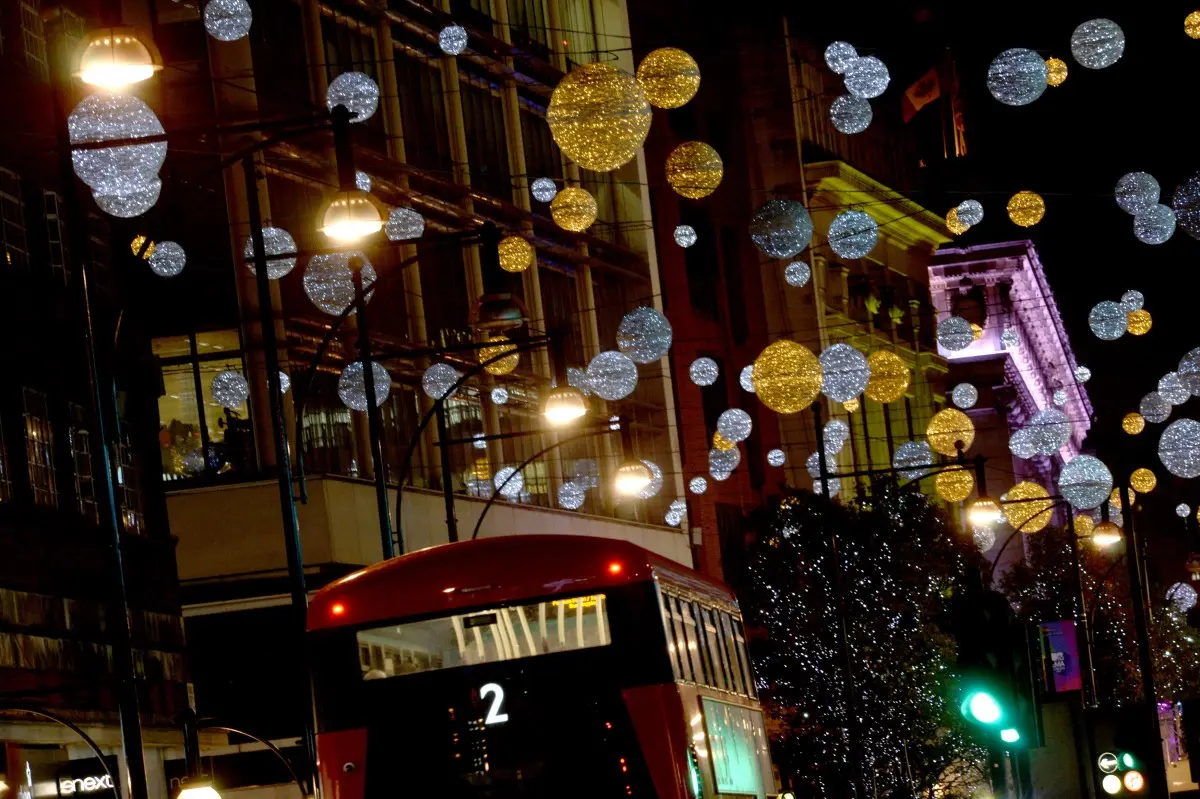
London, Paris, Rome, and Prague have made the list of European cities whose Christmas markets are overly commercialized. This is the opinion of American blogger Helen Sula, who has lived in Germany since 2016 and has visited over a hundred Christmas markets, according to the Daily Mail.
The expert calls the British capital one of the worst destinations for Christmas markets, although she acknowledges that the city’s decorations are fine. Her main complaints concern the popular amusement park in Hyde Park, where admission costs up to 8.25 pounds, and a ticket for a ride on the day of the visit can reach 12.5 pounds.
“In my opinion, Winter Wonderland in Hyde Park is a bit disappointing because of its commercial atmosphere,” Sula notes. According to her, seeing the plastic Christmas trees there is “heartbreaking,” and a plastic cup of mulled wine costs 11–12 pounds.
Italian cities also fail to live up to expectations. The blogger advises against traveling to Rome in the hope of experiencing the atmosphere of Germany, Switzerland, or Austria. She considers Prague a wonderful city, but even there the markets seem a bit too commercial to her, and Paris, despite its festive decorations, is, in her opinion, not a place for Christmas markets at all. Berlin, on the other hand, has so many venues that it’s a bit overwhelming.
Where Prices Are High, and Where They Aren’t
Sula says the markets in Switzerland and Vienna are the most expensive. “Vienna can also be quite expensive. I think it has really gotten more expensive over the years, and I judge that mostly by how much I pay for mulled wine,” the expert notes.
According to her observations, it’s cheaper in smaller cities, such as in the Moselle Valley or in Heidelberg, as well as in France, Tallinn, Kraków, Zagreb, Budapest, Bratislava, and Vilnius. Among her favorites, the blogger lists the Christmas markets in Heidelberg, Strasbourg, Cologne, Bratislava, Vienna, Rothenburg ob der Tauber, and Riboville in Alsace, where locals dress up in medieval costumes. What she values most is authenticity, local goods, and a variety of stalls: at a good fair, Sula says, “you really feel like you’re inside a snow globe, like you’re in a fairy-tale city.”
The British Notice the Difference, Too
Visitors to British fairs share similar impressions. Jamie Eakleff, who has attended fairs across Europe, described the British ones as “not as good” and “a bit more commercial,” according to the BBC. Journalists identified the Birmingham fair as an exception: it is organized by Kurt Strocher, director of the Frankfurt fair; the stalls there are made in Germany, and the food and drinks are brought in from there as well.
Cultural heritage researchers explain why the atmosphere is so important to visitors. “It’s not just about buying trinkets that makes [fairs] special. It’s a holistic experience of sounds, smells, visual images, and the physical presence of the people around you,” says Dirk Spennemann, a professor at Charles Sturt University in Australia, as quoted by National Geographic.