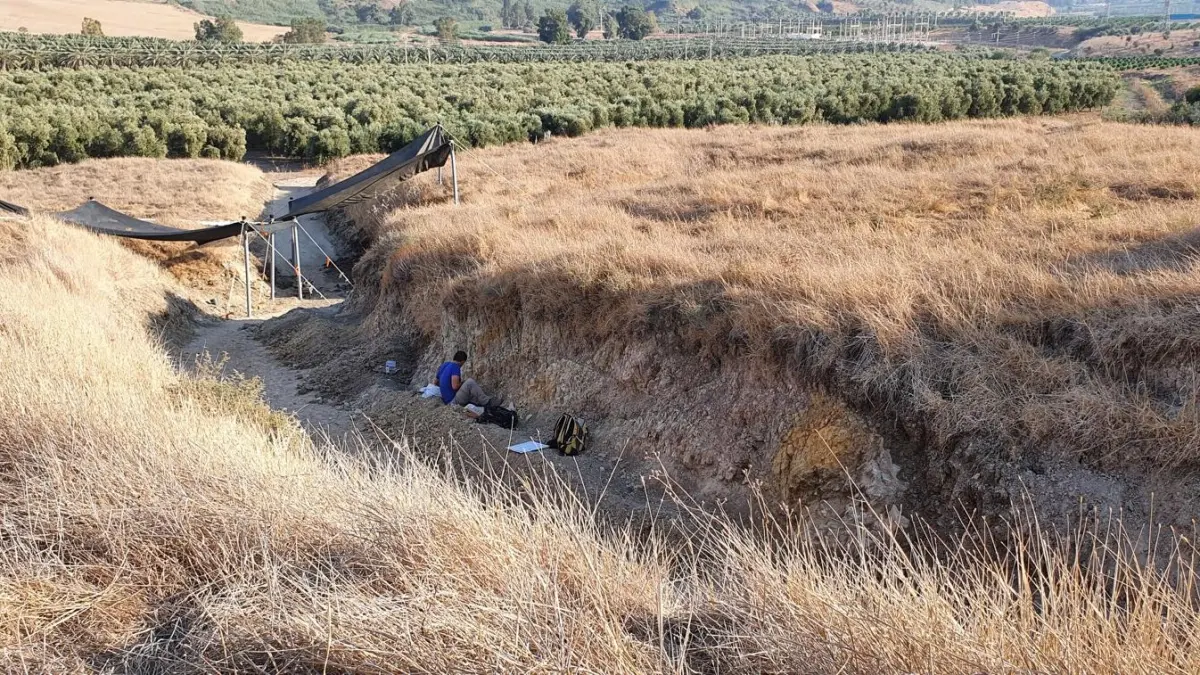
In eastern Turkey, at a site believed to be the remains of Noah’s Ark, researchers from Sivas Cumhuriyet University recovered charred wood from a depth of nine meters. Beneath the surface, they also recorded orderly linear anomalies resembling corridors and what appear to be chambers, according to 24.hu.
This refers to the Durupinar Formation. It is a natural formation approximately 157 meters long, shaped like a drop or a ship. It was discovered in aerial photographs from 1959 near Mount Ararat, where, according to the Bible, Noah’s Ark came to rest after the Flood. Geological studies in 1996 concluded that the depression was formed by a natural mudflow and the compression of rock layers.
So far, only 20% of the radar data has been analyzed, and the age of the wood is still being determined. Independent experts advise against jumping to conclusions. According to them, the wood could have been carried in by water or a landslide, and the artificial-looking outlines on the radar could be caused by natural rock stratification.
Three Levels Underground
The preliminary results were discussed at a symposium dedicated to Noah’s Ark. Professor Atila Zanker, who heads the officially authorized project, confirmed the scan data from American scientist Khosrow Bakhtar, the inventor of the BakhtarRadar system, Metro reports.
Bakhtar, who has worked in defense research for over four decades, is convinced that the device detected man-made structures. According to him, the data processing was configured to filter out natural signals.
“This is the most important discovery in my 45-year career. It has nothing to do with geology, because we filtered out all geological features,” Bakhtar emphasized.
The project team is paying particular attention to the number of levels in the structure discovered beneath the surface, as it matches the biblical description.
“In our Holy Books, Noah’s Ark had three levels, and in our radar surveys, we also discovered a formation with three levels,” Atila stated.
The Ark or a Shepherd’s Fire
The wood samples were sent for radiocarbon dating and species identification. According to the researchers, the samples were taken from deep within the formation, rather than from surface deposits or material that might have been carried by mudflows. Atila promised to release photographs of the find soon.
Andrew Jones, vice president of the project and founder of Noah’s Ark Scans, urges people to approach the discovery with caution.
“This is very exciting, but people need to understand: yes, we may have found the charred remains of Noah’s Ark, but it’s also possible that we’ve found the charred remains of a shepherd’s campfire, which he accidentally started centuries ago while using the ark as shelter,” Jones cautioned.
Meanwhile, hundreds of soil and core samples are being analyzed in laboratories. Further processing of radar data and technical reports are expected in the coming months.