
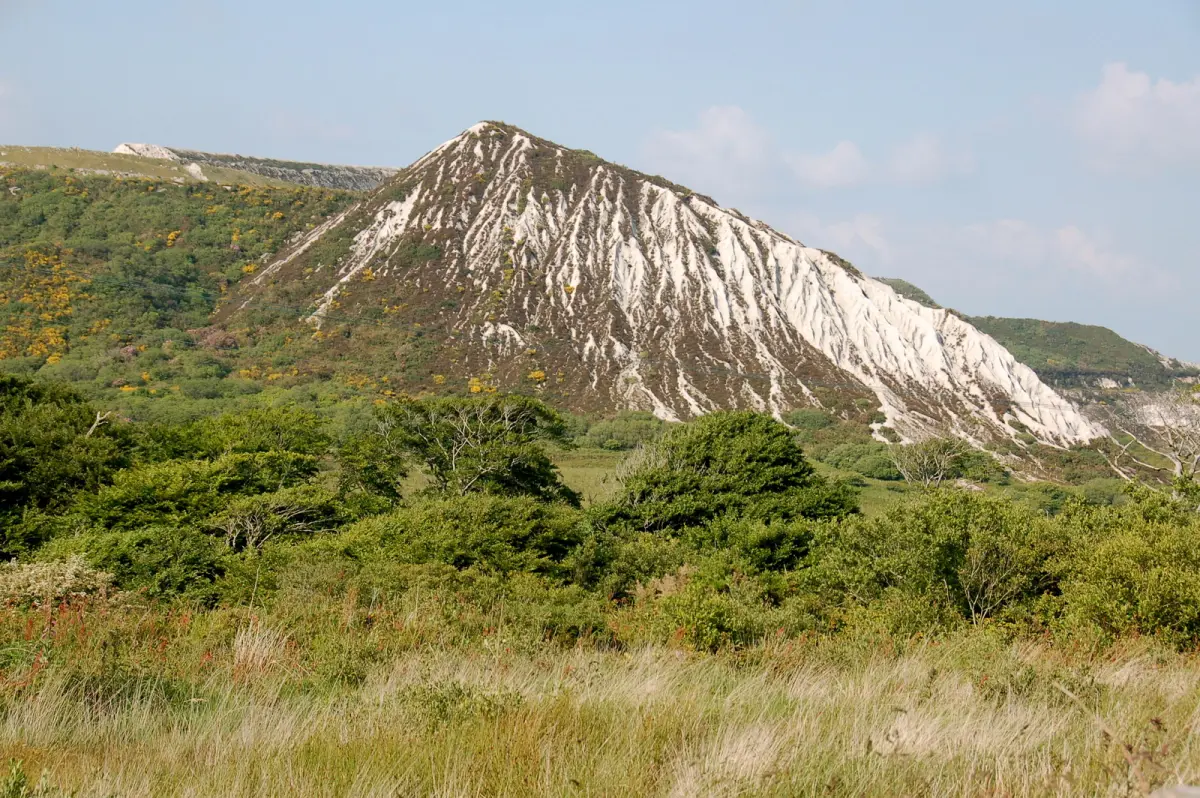
The French corporation Imerys has opened up previously inaccessible areas of the so-called “Cornwall Alps”—an industrial kaolin mining region around St. Austell in southwestern England—to travelers. In 2025, the company added 34 km of new trails, bringing the total length of the network to 62 km, according to BBC Travel.
The trails run through private land but are open to everyone year-round and free of charge. Many of them are also accessible to cyclists and horseback riders. Some of the trails connect to the Clay Trails network, which leads to Par Beach and the Laksulian Valley. Since the trails run alongside quarries and processing sites, straying from the marked routes is not recommended.
Over 250 years of mining have transformed approximately 91 square kilometers of farmland and heathland into a landscape of massive quarries, green lagoons, and man-made pyramids. For every metric ton of clay, up to nine metric tons of waste were produced, from which at least 100 light-colored cones emerged. Today, only a few remain. The flooded quarries, with their milky-turquoise water, resemble glacial lakes; however, swimming in them is dangerous and strictly prohibited.
“It’s about 50 yards (46 m) deep and about the width of a football field, but beneath the surface there’s probably about 48 yards (44 m) of Chinese clay, which is why the water is that color,” says Steve Hocken, a Lansalot native who worked in the industry for 37 years and is now a volunteer guide at the Wheal Martyn Museum.
From “white gold” to a forest
Kaolin deposits were discovered here in the mid-18th century. In 1910, Cornwall accounted for about half of the world’s production, roughly one million metric tons per year. The industry has declined, but reserves will last for another decade: they contribute about 40 million pounds to the local economy each year. When Imerys proposed razing the Sky Tip spoil heap in 2014, residents fought to save it, and now the Cornish flag flies atop it.
Abandoned sites are gradually being returned to nature. The Eden Project now operates in the former Bodelva quarry. In Dabbury, more than 100,000 trees were planted by the end of 2024, and new trails up to 6.4 km long wind through forests and wastelands inhabited by red deer and wolverines. Molly Earl is also relocating bee colonies rescued from chimneys and other structures to this area.
“Nature always finds a way,” Earl smiles, recalling how the landscape has changed since her childhood.
The color of the water in the flooded quarries depends on the amount of suspended clay particles. Many deposits have been abandoned in favor of other sources of kaolin, primarily in Brazil, according to NASA.
The shift of production to Brazil has already cost the region jobs: in 2007, Imerys cut 500 jobs in Cornwall, citing the need to preserve the rest of its operations in southwest England, BBC Cornwall reported.