
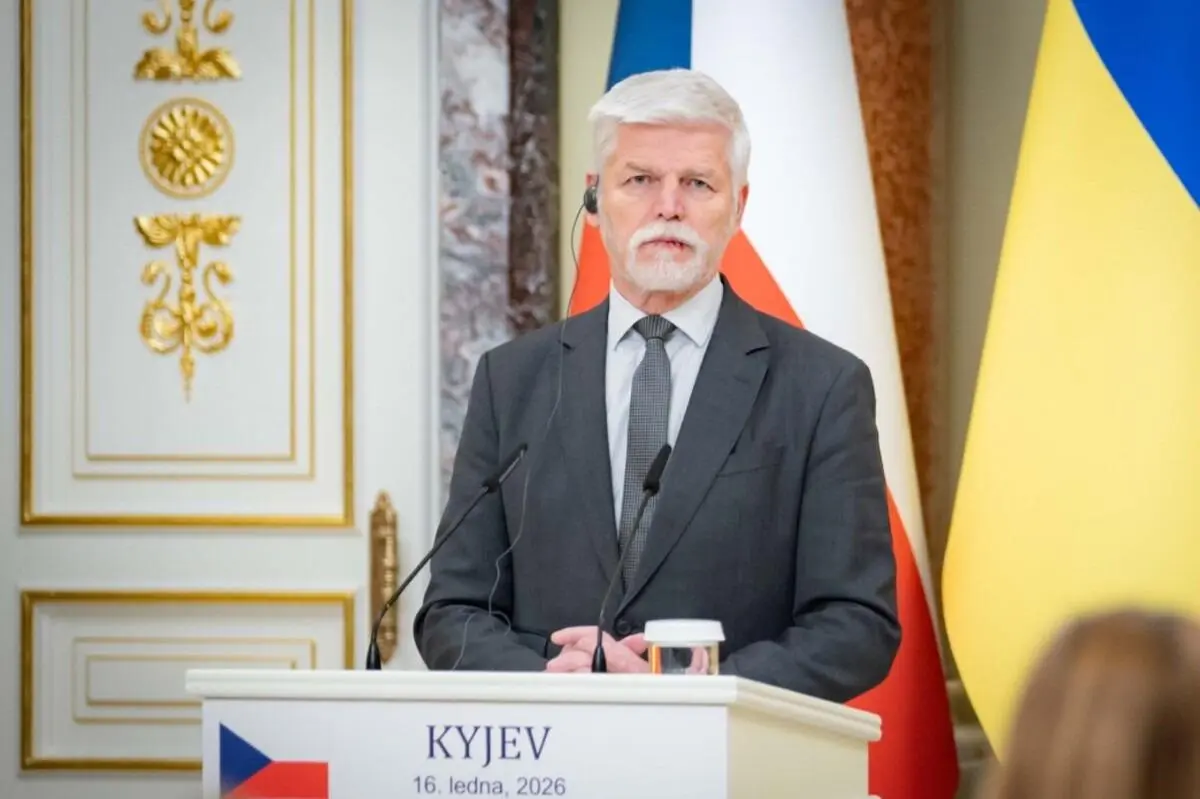
The question of who will represent Europe in upcoming negotiations with Vladimir Putin is not on the agenda, and there have been no official consultations on this matter. This was how Czech President Petr Pavel responded, following a meeting of the heads of state of the Visegrad Four in Trenčín, to reports in the British press that named him as one of the possible lead negotiators for Europe, according to Infostart.
The Czech leader speculates that the British publication reached this conclusion because he has recently spoken out publicly on numerous occasions about the war in Ukraine and the security situation.
“Since there is currently no discussion at the European level about how to approach this issue at all, there have been no negotiations regarding potential candidates either. The Telegraph mentioned my name among several others, but I would call this a journalistic conclusion. There were definitely no consultations,” Pavel stated.
When asked directly whether he would accept such a role if an official offer were made, the president clearly distinguished his personal plans from his willingness to provide professional assistance.
“I have no such ambitions at all. Of course, I would be happy to contribute my experience gained at NATO and the European Union to the process, but in any case, it is up to the European countries themselves to decide whom they want to see as their representative,” he emphasized.
The former chairman of the NATO Military Committee warned that numerous separate peace initiatives are uncoordinated and therefore fail to produce a breakthrough. If Europe does not reach an agreement quickly—particularly within the framework of a “coalition of the willing”—it will be easier for Russia and the U.S. to simply exclude the continent from the peace process.
A list of five leaders
In October, The Telegraph, citing diplomatic sources, reported that European leaders were selecting negotiators to hold talks with Putin, and that offers had already been made to some candidates. Among the names are Giorgia Meloni, Alexander Stubb, Petr Pavel, Mette Frederiksen, and Jonas Gar Støre. The impetus for this came from more than a year of unsuccessful U.S. mediation and fears that Donald Trump no longer defends Europe’s interests, The Telegraph writes.
Previous attempts to elect a single leader have failed: European Council President António Costa declined the role. According to the publication, it is more likely that a group of leaders will be selected. In an interview, Pavel himself called for identifying a person or group to speak on behalf of Europe.
“President Putin ignores the European Union as an authority. He doesn’t want to talk to Ursula von der Leyen; he doesn’t speak with Kaja Kallas. He has stopped talking to other European leaders, including Emmanuel Macron,” the Czech president noted.
Does Moscow Need the Europeans?
Prague Castle spokesperson Daniel Drake declined to comment on the closed-door negotiations, while Foreign Minister Petr Macinka promised Pavel his full support should he receive a mandate from the EU. Pavel Havlíček, an analyst at the Association for International Affairs, believes the formation of a European negotiating team is a realistic possibility, but doubts the Kremlin’s willingness to accept it, as Moscow prefers talks with the U.S.
“Involving Europeans will certainly not be their priority. At best, it should be Ukraine, not other European countries,” the expert warns in a comment to Blesk.