
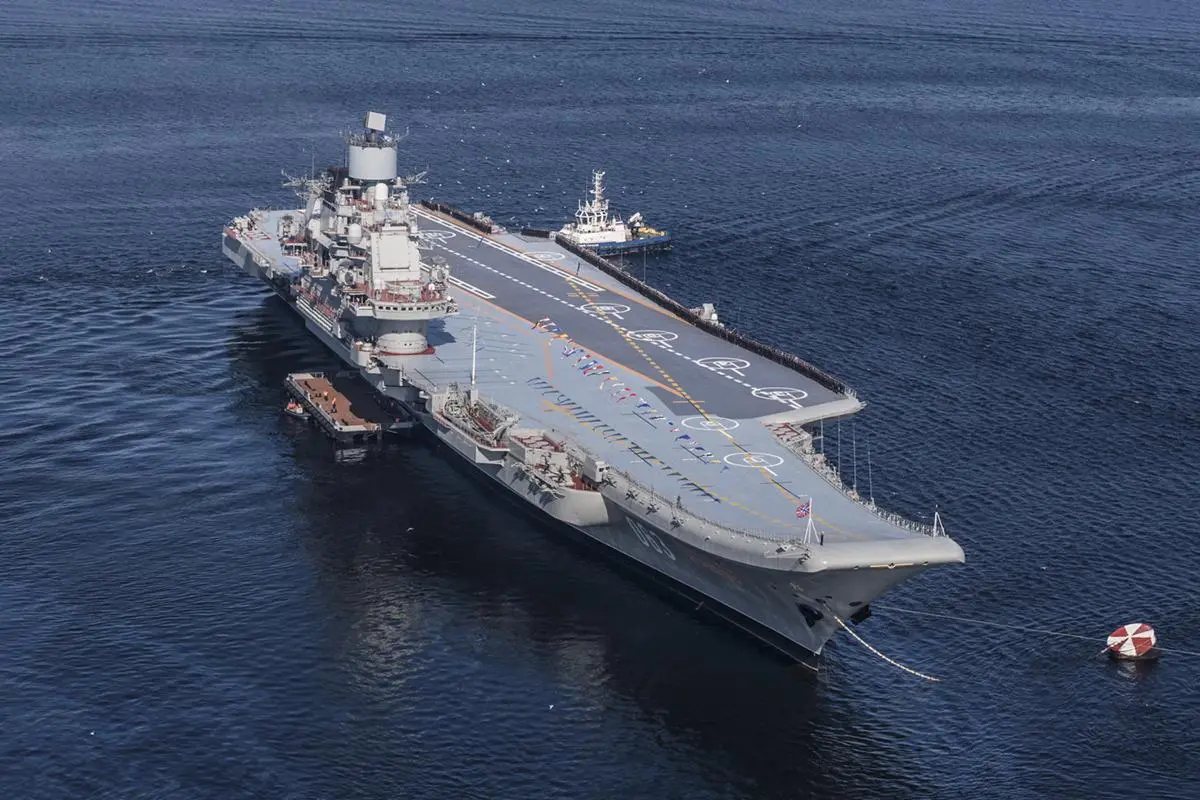
Russia has effectively decommissioned the two largest ships in its surface fleet: its sole aircraft carrier, the *Admiral Kuznetsov*, and the nuclear-powered heavy missile cruiser *Peter the Great*. Formally, both are still listed as part of the Russian Federation Navy (RF Navy), but they have no hope of returning to service, according to 19FortyFive.
The “Admiral Kuznetsov” has been docked in Murmansk since 2017. Its major overhaul was intended to extend the ship’s service life by another 25 years, but work has been suspended since 2024. According to Russian media reports, the “Peter the Great” will not undergo the same modernization as the “Admiral Nakhimov,” which is of the same class. The problem with the cruiser is not its technical condition, but its cost: maintaining a 26,000-metric-ton nuclear-powered ship is beyond the fleet’s budget. The modernization of the “Nakhimov” has been ongoing for 27 years.
A Repair Job That Turned Into a Nightmare
Accidents plagued the aircraft carrier’s repairs. In 2018, Russia’s largest floating dock, the PD-50, sank, and a falling crane punched a large hole in the flight deck. In 2019, a fire broke out on board, claiming the lives of two people and injuring more than a dozen workers. The ship’s chances were ultimately dashed by the war against Ukraine, which drained Russia’s defense budget.
Due to the disruption of supplies from Ukraine after 2014, the power plant had to be built from scratch in Russia, and engineers discovered that all eight boilers needed to be replaced, not just four. In July 2025, *Izvestia* reported that the modernization had been suspended, and Andrei Kostin, head of the United Shipbuilding Corporation, stated that there was no point in repairing the old submarine. He warned that this would be “an extremely expensive undertaking” that could divert the corporation from its primary mission—the construction of new submarines, according to USNI.
Ultimately, the Commander-in-Chief of the Russian Navy decided to mothball the aircraft carrier: usable equipment will be transferred to other ships, and the hull will be maintained by the crew on duty. Completion, sale, or scrapping remain options for the future.
Focus on Submarines
Instead of large surface ships, Moscow is expanding its submarine fleet: between 2013 and 2025, the Pacific Fleet received 13 new submarines, including five Borei-class nuclear-powered submarines. Russian President Vladimir Putin called this expansion “crucial” and announced four more such submarines, according to Foreign Policy.
Some Russian military leaders consider the shift away from surface ships to be a natural development given the advancement of anti-ship weapons.
“The Russian Navy does not need aircraft carriers in the traditional sense. An aircraft carrier is a relic of a bygone era. It is a massive, expensive structure that can be destroyed in a matter of minutes by modern weapons,” says Sergei Avakyants, former commander of the Russian Pacific Fleet.