
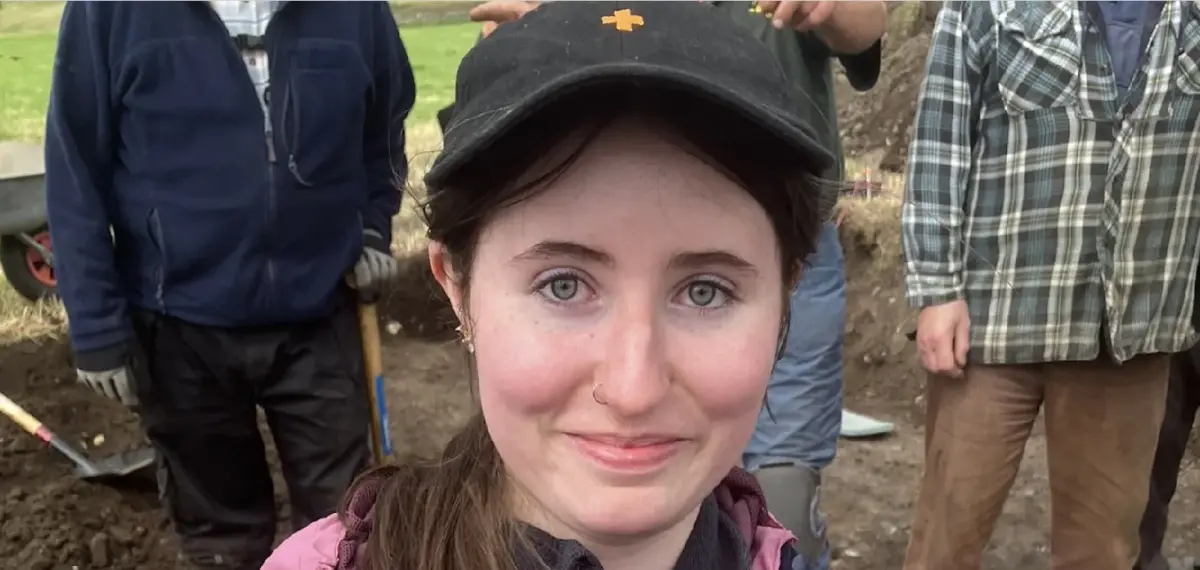
Eliza Zallu, a freshman at Newcastle University, found a Roman gold chain nearly 2,000 years old on the very first day of her excavation. The fragment, about 7 cm long, was discovered in Redsdale (Northumberland), on the former northern border of the Roman Empire. It is so well-preserved that, if it were intact, it could still be worn today, according to Die Welt.
Prior to this field trip, the student had never worked with an archaeological trowel in the field.
“It was truly surreal, especially since it was the first day of my very first excavation. I never expected to find anything like this at all in my entire career,” Zallu said.
Instructors emphasize that even for experienced specialists, such a find is a rare stroke of luck.
“Finding a gold artifact is something many archaeologists never experience in their entire careers. For a freshman who discovered a beautifully preserved Roman gold chain on her very first day at the excavation site—it’s simply amazing,” noted Eric Tourigny, a professor of historical archaeology at Newcastle University.
The chain was made using the “loop-in-loop” technique: the rings were compressed into a figure-eight shape, bent, and intertwined. This method is considered a hallmark of the highest craftsmanship among Roman jewelers. Such items were typically made from exceptionally pure gold and were associated with the jewelry of the elite, military amulets, or the regalia of high-ranking officers and their families, according to a statement from Newcastle University.
Jupiter’s Seal and the Mysterious Lead
In the summer of 2026, 52 first-year students participated in the excavations. They worked in two groups for two weeks each, alongside volunteers from a local archaeological group. On that very first day, student Shannon Wood found a folded sheet of lead bearing a Latin inscription in cursive. It could be a commercial seal or a so-called “curse tablet,” on which the Romans would scratch out prayers, complaints, and curses. The inscription has yet to be studied.
On the second day, Megan Potter discovered a gilded bronze crescent-shaped ornament from a cavalry officer’s equipment. Researchers speculate that it may have belonged to a cavalry officer. During the final week of the season, the students found a carnelian intaglio—that is, a seal for a ring—depicting Jupiter. This is already the fourth such stone found at this site. Other finds include coins, spearheads, and fragments of pottery bearing the name “Martinus.”
“A gold chain, a gemstone seal, inscribed pottery, and an ornate brooch shed light on the lives of the people who kept this place running nearly two millennia ago. Together with the buildings and production facilities the team is excavating, they also help us understand how the frontier functioned and how Roman and local communities interacted,” emphasized excavation director Richard Carlton.
The site at Redsdale has been under investigation since the early 1990s. The current project began in 2021: archaeologists are studying the remains of two large fortified outbuildings attached to the camp, along with defensive structures, buildings, roads, and evidence of production.