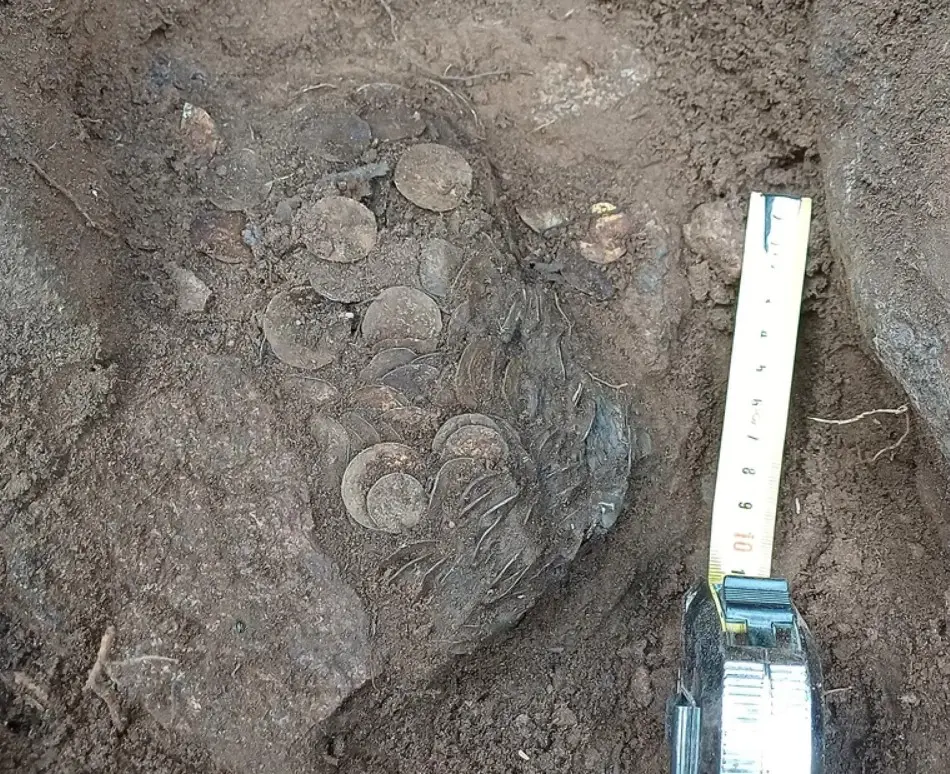
Archaeologists in Hungary have uncovered a hoard of more than 200 Celtic silver coins that are over 2,000 years old. It was discovered between 2023 and 2025 during excavations conducted prior to the construction of a power substation in the western part of the country. The hoard dates to the late 2nd–early 1st century B.C. It is one of the largest finds of its kind in Hungary in recent decades, according to Live Science.
The coins were discovered on the site of a new power substation being built by the energy company E.ON in the city of Szombathely. The hoard weighs over two kilograms and was buried at a depth of 30–40 centimeters. These are tetradrachms of the so-called Velem type. The Celts hid them in a pit and placed some of them in a small vessel, according to Diplomacy & Trade.
Since the hoard was buried shallowly, it had been damaged by plowing over the centuries. At first, archaeologists found only a few coins, but later, working with experts using metal detectors, they gradually reached the central part of the hoard.
The work at the site was carried out by specialists from the National Institute of Archaeology of the Hungarian National Museum. In total, they examined nearly 400 archaeological sites and found several thousand artifacts dating from the 5th millennium B.C. to the early modern period.
From a stone axe to a dog paw print
Among other finds are a polished stone chisel-axe dating back nearly 7,000 years and a glass bead with a “peacock’s eye” pattern from the Early Iron Age (7th–6th centuries BCE). Archaeologists also found two intact millstones from a hand mill dating to the Celtic period.
During Roman times, there was a villa on this site. Archaeologists were able to partially reconstruct the layout of its central building, which covered an area of about 300 square meters. It was there that they found a fragment of a brick bearing a dog’s paw print. It is likely that such bricks were used to line the firebox of a Roman underfloor heating system.
The finds will soon be on display at a temporary exhibition at the “Savaria” Museum in Szombathely. The Szombathely North substation, costing 7.5 billion forints, is already operational at the excavation site.
Celtic Silver in Museum Collections
The Hungarian National Museum houses a collection of nearly 6,000 coins from the Celts and other ancient peoples of the Carpathian Basin. Among the previously known finds is a hoard discovered in the fall of 1903. It contained about 2.5 kg of silver coins of the Totfalus type, which were likely minted by the Boii tribe in the first half of the 1st century BCE, according to the Hungarian National Museum.